A Puzzle of Muon and Decay Light in EJ-200

Versions

Description

Dear FLUKA experts
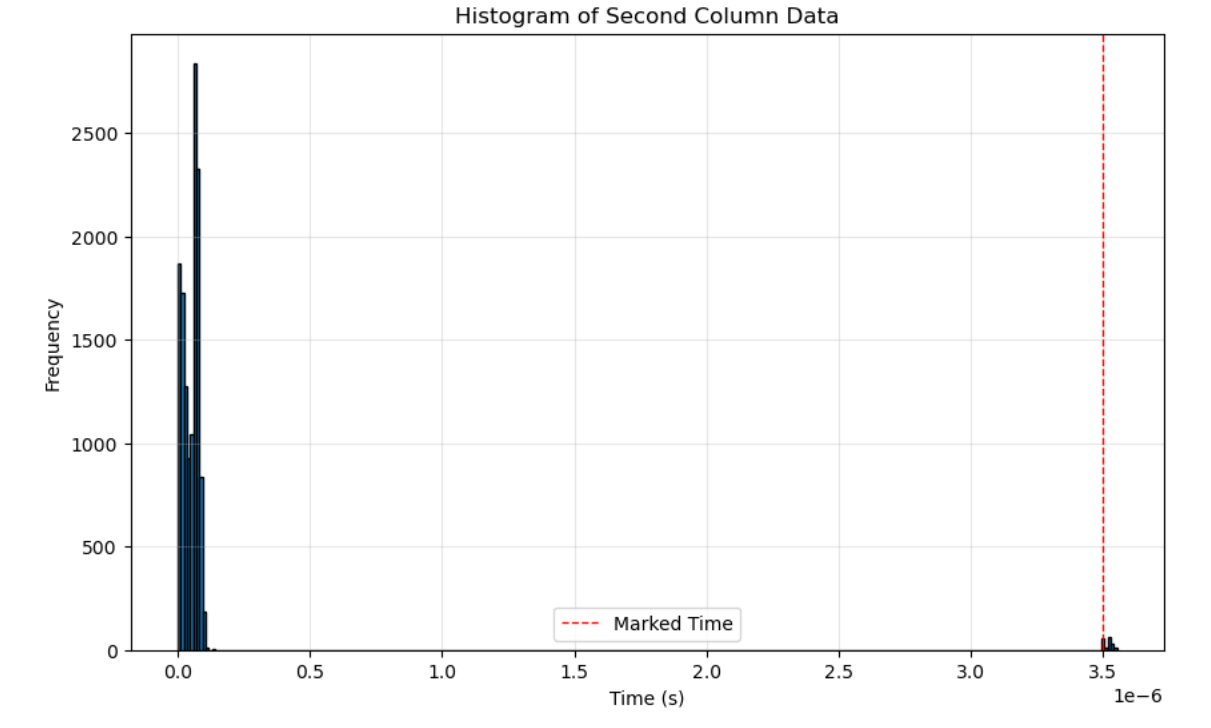
I have a question. Currently, I have a model (muons incident into an EJ-200 scintillator, with fluscw recording the emerging visible light photons from EJ-200). I have obtained the following information (two peaks are clearly visible—one from the visible light excited by the energy deposition of muons, and the other from the visible light excited by decay electrons). However, I am unsure why the second peak is so much smaller than the first one.

Input files

fluscw.f (6.1 KB)

FLUKA_geometry.inp (2.6 KB)
Dear Jianqi,

thank you for your question. I will come back to it next week.

Thanks for your patience. Best regards,

Tommaso

Dear Jianqi Chen,

I have inspected your model and considered some physics aspects.

Due to the detector thickness, the entire muon energy (2 GeV kinetic) is deposited in the detector. The resulting visible light accounts for the prominent first peak that you observe.

You correctly identify the second peak as the visible light coming from positron contribution. The positron energy is ~50 times lower (rough average) than the muon energy, leading to a significantly smaller number of photons generated. Consequently, the second peak is smaller.

In conclusion, I believe that your observations have a clear physical explanation.
Best regards,

Tommaso

Dear Tommaso,

Thank you for your answer, now I know why.

Best regards

Yongce Gong