together with H*(10), I am trying to estimate the absorbed dose in nine detectors (DET2–DET10), which are air spheres of 50 cm radius placed outside a radioactive waste storage facility in a skyshine configuration (DET1 is instead inside the facility, with a 20 cm radius, and serves as a check on the source). The aim is to obtain the ratio between the two quantities for each sphere.
For H*(10) I use USRBIN with region binning and, since it is track-length based, I have no difficulty in reaching uncertainties below 5%. With the absorbed dose, however, which relies on energy deposition, I cannot obtain usable results because of the very few interactions occurring in the air spheres. I tried EMF-BIAS to reduce the photon mean free path, but it appears that this is not yet implemented for photons
(FLUKA 4-5.2; the run stops with STOP: EMFIN-PHOTON-INT-BIASING-NOT-YET-IMPLEMENTED. The input I used is attached.)
Could you suggest other approaches? I am aware that kerma (under charge particle equilibrium) can be scored with any track-length estimator by applying the weighting factor f = [μ_en(E)/ρ]·E through the FLUSCW user routine, but I would prefer a direct energy-deposition estimate in the spheres.
The fact that you are getting reasonable statistics from your track-length based scorers implies that a sufficient amount of (virtual) particles is crossing your regions of interest (air spheres). That means a two-step approach could be applicable here where you record the particles entering a sphere using mgdraw.f and then repeatedly sample those particles using source.f. The approach is described -not very much in detail- starting at slide 40 in the Radiation Protection Course material. The example given there is actually quite similar to your sky-shine application. As suggested in slide 41, verify that you have a sufficiently smooth photon(-energy) spectrum impinging on the sphere to avoid correlations in your sampling.
For gaseous detector media, there is also the trick of artificially increasing the density and then downscaling the result. However, one needs to be careful to keep the product
attenuation coefficient (cm2/g) x density (g/cm3) x detector dimensions (cm) << 1
to avoid distortion of the physics (i.e. the probability for a single scattering event inside the sphere should dominate). For 1-MeV gamma rays going through 100 cm of air, however, the factor is already on the order of ~0.01-0.1, so this won’t help much in your case.
thank you, the density-scaling trick is something I was not aware of and I would like to make sure I apply the validity criterion correctly before setting up the run.
Which photon energy should I consider for µ/ρ?
My source is Co-60 and µ/ρ in air is 0.0569 cm²/g, but in my detectors spheres the spectrum is strongly degraded: the fluence-weighted mean energy is about 130 keV. In the latter case the µ/ρ is about 0.142 cm²/g. Is it better to consider the wrong case µ/ρ=0.142 cm²/g?
With µ/ρ = 0.142 cm²/g (air, 130 keV), ρ = 1.205×10⁻³ g/cm³ scaled by a factor 10, and d = 100 cm (the sphere diameter), I obtain 0.17. Could this be okay?
Finally, how can I do the downscaling of the results both for H*(10) and absorbed dose?
In general, the interaction cross section (attenuation coefficient) for air at the energies of interest (few MeV to few keV) increases monotonously with decreasing energy. X-ray absorption edges typically break the monotony, but there’s almost no effect for air due to the low masses of the constituents. Therefore, choosing a low energy where your incoming spectrum still has sufficient fluence is a conservative choice.
The conservative value you calculated indicates that about exp(-0.17) x 100% = 84% of all 130-keV photons traverse the detector without reacting. This means:
The probability of reacting at least once is 16%.
The probability of reacting exactly once is very roughly 0.16 x 0.84 ~ 13%. This assumes that the energy does not change after the first reaction (or that the attenuation coefficient is similar for the scattered particle) and that the traveled distance is on the order of 100 cm.
The probability of reacting twice is roughly 0.16 x 0.16 ~ 2.6%, using the same assumptions as above.
The ratio of double- vs. single-scattering probability is about 20%. This is a significant contribution of non-linearly density-dependent multiple-scattering events. I would not recommend to extrapolate this value to lower densities.
I hope this made the reasoning behind the “… << 1” condition in my first reply more clear. There are plenty of assumptions that go into this. However, all of this can be tested with FLUKA.
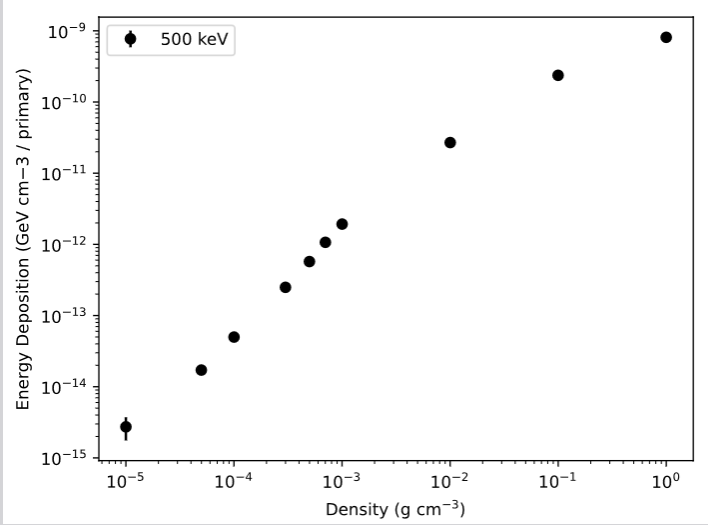
Therefore, I performed a simple FLUKA simulation in which I directed a 500-keV pencil beam at one of your air detectors and recorded the energy deposition with a USRBIN scorer. I varied the density of the air between 1.0 g/cm3 and 1e-5 g/cm3 in 10 steps. The input and a figure that summarizes the results are attached.
In the results, you can see that this has a regular (but still not linear!) behavior only at densities below the standard air density at about 1e-3 g / cm3. Increasing the density artificially will introduce more and more nonlinear effects that cannot be extrapolated to lower densities. At the energy you named, extrapolation would be even less justified.
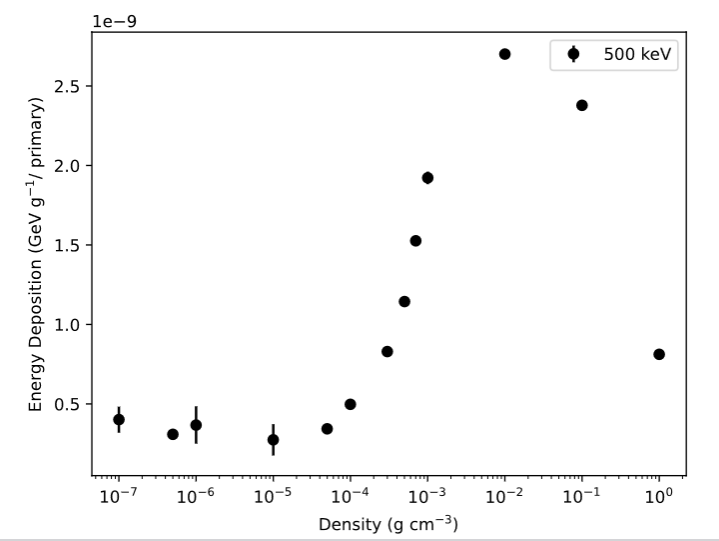
On the density discussion: I simulated a few even smaller densities and visualized the results in a smarter way:
Ideally, one would like to be able to scale the results like
edep (rho_2) = edep (rho_1) * rho_2 / rho_1
where edep is the energy deposition and rho_i two different densities, i.e. the energy deposition should depend on the density like:
edep / rho = const
The plot below shows the energy deposition divided by the density, resulting in an energy deposition per mass unit. This approaches a constant value only beyond 1e-5 g/cm3.
The problem with photons at the energies of interest is that they almost never deposit their entire energy in a single interaction. The scattered photon and secondary particles often have a shorter path length left for interacting with the detector medium, but their higher interaction cross sections balance this. This means that there are almost always multiple interactions in such a large detection volume.