I tried to generate the organ absorbed dose due to neutron for AP irradiation geometry using the MRCP mesh phantom. Although for photons, I could reproduce the values given in ICRP 116, but for neutrons the values are quite smaller than those given in ICRP 116. One such example is ID 6100 representing brain. For 1 MeV neutron, for male, simulation value 1.245 pGy-cm^2 and for female: 1.368 pGy-cm^2 , whereas the ICRP values are 6.46 and 7.4 respectively. [the excel file is attached here for convenince].
I carried out additional simulations with Voxel phantom and same neutron source geometry and I kept all other cards similar to the above inputs. This resulted nearly similar results as given in reference of ICRP 116. With voxel phantom, I could get expected dose deposition for all energies and organs.
Hence, is the discrepancy due to mesh geometry? Can you please guide if any additional card needs to be added for neutron dosimetry in mesh phantom?
I found a mistake in your source code source_newgen.f, the energy flag is set incorrectly. The comment in the code (energy_logical_flag = .true.) have not been removed, therefore, the momentum_energy value set in the previous step represents the momentum of the neutron.
Additionally, for neutron dosimetry, one reference mentioned the following settings in Geant4:
“The thermal neutron scattering treatment S(alpha, beta) for hydrogen in light water at 300K was activated to take the thermal vibration of molecules into account. The range value of 1 micron for the secondary production cut was set to all the particles.”
similar to this, is it needed to set the following values in LOW-PWXS?
IAZ corresponds to hydrogen and h_w = is it light water? What should be the Step length in this case?
Also, how to set the range value of 1 micron for the secondary production cut?
Thanks for the question. The mistake in the routine correctly pointed out by @Chuanye90, should solve the issue. I have done extensive calculations with the mesh phantoms and the value that you currently get is indeed the one for roughly 0.5 keV neutrons (whose momentum is 1E-3GeV/c).
As far as the LOW-PWXS card is concerned, you should apply it to hydrogen only: put HYDROGEN in the Mat field and leave the to Mat field empty. If you didn’t update the input file that you shared here, please remove the LOW-NEUT card.
In FLUKA we do not set the value of the range to stop the particle transport but their energy (see lecture on EM interactions and thresholds). The thresholds for electrons/positrons/photons that you have look appropriate to me. You may want to lower the transport thresholds of light ions (4-helium, 3-helium, trions, deuteron).
(a) in LOW_PWXS, should I keep IAZ and S (alpha,beta) empty or should I keep 10010 and h_w as before?
(b) can you please explain the meaning of Mat entry with respect to IAZ and S(alpha, beta) entries? In this present case, Mat is hydrogen and IAZ also corresponds to hydrogen. Is there any situation when they will be different or will they be same in all cases?
(c) the LOW_NEUT is only required for group wise treatment, not point wise, hence not required here. Is it so?
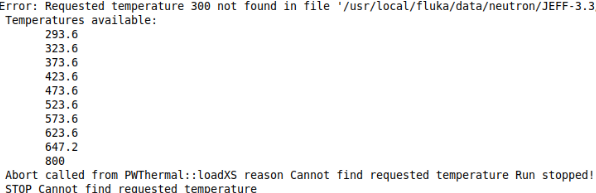
Also, (d) if I use T = 300 K, the attached error is generated. Does this mean I can use only these temperatures?
b) The material HYDROGEN corresponds to natural hydrogen with the correct natural isotopic composition, thus including deuterium. Setting IAZ to 10010 means selecting the S(a,b) for H-1 only.
c) Yes it is required for group-wise treatment so you should remove it.
d) Contrary to Doppler broadening, which can and is performed at initialisation,the files for thermal scattering in these libraries must be prepared beforehand and thus available for selected temperatures only. You can leave the T field blank, in this way the one for 293.6 K (default) is used. This is also the default temperature used for Doppler broadening the neutron cross sections for all materials.