Clarification on USRBIN (region) + DCYSCORE units

Dear FLUKA experts,

I am still a beginner in particle physics and I have been working with FLUKA for almost 1 year now. However, several points remain unclear to me, and I would like to get some clarification regarding the units of USRBIN in REGION mode.

In my work, I need to estimate the energy deposition, the prompt dose (over 200 days of irradiation) and the residual dose (1 s cooling time) in a Cu volume.
Here, as an example, I will consider a simple case of a proton beam hitting a titanium cylindrical target.

1 - Concerning SCORE card and USRBIN card (region type)

These two cards seem to output the same value (not exactly identical, but close enough) and the corresponding unit is [GeV/region/primary] as explained in the official manual.
To convert this into dose [Gy/primary], we first need to divide by the volume of the region, then by the density \rho [g/cm3], and finally multiply by 1.602176462E-7.

We can also perform the same USRBIN but for part:DOSE. If we compute the ratio ENERGY/DOSE, we obtain exactly \rho. Does this mean the raw dose value output by FLUKA has units [GeV.cm3/g/primary]?
In that case, to convert it into [Gy/primary], we should divide by the volume and multiply by 1.602176462E-7. Finally, I need to multiply the result by the total number of protons in 200 days to obtain the dose in [Gy] for 200 days.

2 - Concerning USRBIN (region type) with associated DCYSCORE
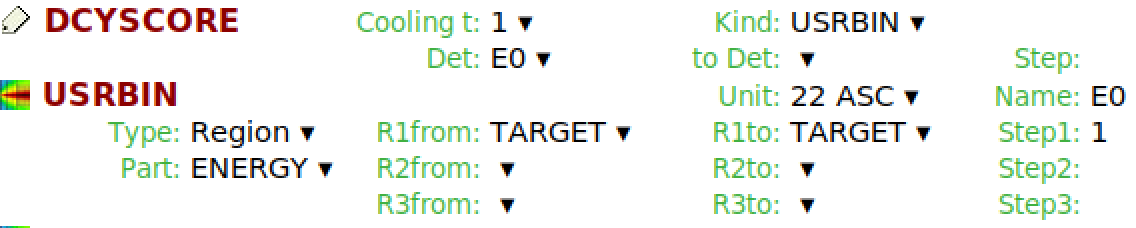
To make this work properly, I also used RADDECAY, IRRPROFI (200 days irradiation times and 3.12 x 10^15 proton/s) and defined DCYTIMES.
The DCYSCORE manual states:

Warning: when the DCYSCORE option is applied to a detector with WHAT(1) > 0.0 , all quantities are expressed per unit time (in seconds). For instance, the RESNUCLEi estimator will output Bq, dose estimators will provide dose rate, etc.

Since I defined 1 s in my second entry of DCYTIMES, WHAT(1) = 2 (> 0.0), therefore the output of my USRBIN should be expressed in [GeV/region/s].
Now, if I perform the same scoring with part:DOSE, I still observe the same factor \rho between ENERGY and DOSE. Does this mean that the dose unit in this case is [GeV.cm3/g/s] ?
If so, to obtain the dose rate [Gy/s], I should divide by the region volume and multiply by 1.602176462E-7.

In this situation, am I correct in understanding that this result corresponds to the instantaneous residual dose rate at 1 s after the beam stop, and not the accumulated dose over 200 days ?

Does this interpretation make sense to you ?
Also, is there any standard or recommended way in FLUKA to directly obtain the prompt dose accumulated over N days of irradiation ?

Thank you very much in advance for your help.

Best regards,

Julien.

Fluka Version:
FLUKA: 4-4-1
Flair: 3-3-1

Fluka inputs:
TargetScoring.inp (2.9 KB)
TargetScoring.flair (4.4 KB)

Dear Julien,
Here the answers to your questions concerning the prompt part:

  • SCORE with ENERGY and USRBIN with ENERGY (REGION-type scoring) provide the same physical quantity, i.e. the deposited energy in [GeV/region/primary]. The difference is that SCOREprints the value for all regions by default, while USRBIN only prints the region(s) you specify (WHAT(4), when using the REGION-type scoring with WHAT(1)=12). As stated in the manual, USRBIN is a more flexible way to score by region (you can also easily compute the average value with the associated statistical uncertainty over cycles)
  • Your conversion from [GeV/region/primary] to [Gy/primary] is correct:
    • divide by the region volume [cm3];
    • divide by the density [g/cm3];
    • multiply by 1.602e-7 to convert [GeV/g/primary] to [Gy/primary]
  • When you use DOSE as particle type in a REGION-based USRBIN, the raw quantity has units [GeV / ( (g/cm3) * primary) ]. This is the deposited energy divided by the density. To obtain the absorbed dose, divide by the region volume [cm3] and apply the [GeV] to [Gy] conversion factor (as above)
  • To obtain the absorbed dose accumulated over a given irradiation time, you have to multiply the dose [Gy/primary] by the total number of primaries (protons in your case) over that time (-> 3.12e15 p/s x 200 days = 5.39e22 protons)

Now regarding the decay / residual part:

  • It is not completely clear to me if you want to score a residual dose rate (for radiation protection of personnel) or something similar to a decay heat (thermal power produced by the radioactive decay)
  • If you use RADDECAY + IRRPROFI + USRBIN (with DOSE, REGION) + DCYSCORE, then you get an energy-density deposition rate [GeV/ (g/cm3 ) * s)] by the decay radiation. After converting to [Gy/s] (as explained above), this corresponds is the instantaneous absorbed dose rate at the chosen cool-down time (in the input file you provided, you have selected 0 s, which is means immediately after beam stop). This is not the accumulated absorbed dose over 200 days.
  • To compute the prompt accumulated dose during irradiation, you do not need any activation calculation — simply use the prompt dose per primary, as explained above.

One point of attention: in your RADDECAY card, you defined WHAT(5) in such a way that the transport of prompt electromagnetic cascade is “instantly” killed. This will result in a wrong simulation of the prompt deposited energy.

I hope this helps!
Cheers
Fabio

1 Like

Thank you very much @fpozzi for your detailed answer. It helped a lot and confirmed my understanding.

From my current interpretation (as I just started working on this “residual dose rate”), what we are actually looking for is indeed something similar to a decay heat, reflecting the activation of the material.

A few quick follow-ups:

1/ RADDECAY - prompt cut (WHAT(5)):
Thank you for pointing out the prompt-cut issue. I indeed saw that my current setting kills the prompt EM cascade and impacts the energy deposition inside my components.
Could you confirm the best practice here? My understanding is that setting WHAT(5)=0 allows full transport of the prompt EM cascade (more realistic, but slower), whereas a large value speeds up the run at the cost of a biased prompt energy deposition. Is there a recommended default value for WHAT(5), or is the only robust approach to perform empirical convergence tests (vary WHAT(5) and take the largest value that leaves the scored energy unchanged within tolerance)?

2/ PART-THRESH and TIME-CUT:
I believe the same convergence approach applies to these cards. Is there any additional FLUKA-specific diagnostic or recommended practice to decide when a TIME-CUT is “safe”?

Many thanks again for the clarification, very useful.
Best regards,
Julien

Thanks Julien for your patience!

1/ RADDECAY
Yes, setting WHAT(5)=0 means that this field is ignored, which in practice implies that the transport energy cutoffs remain unchanged for both the prompt and the decay parts of the simulation. There is no single “ideal” value for these settings: they depend on the specific problem being addressed. The convergence-based approach you propose is therefore meaningful and appropriate.

2/ PART-THRESH and TIME-CUT
The TIME-CUT card kills particles whose time of flight exceeds a given value. It does not represent any physical decay or absorption process, but rather a numerical truncation of late particles. In your case, I do not think this option is relevant.
If the goal is to improve CPU performance, the recommended approach is instead to act on the energy thresholds defined via EMF-CUT (and, consequently, on the corresponding thresholds applied to the prompt/decay radiation through RADDECAY).

Cheers
Fabio
