Description
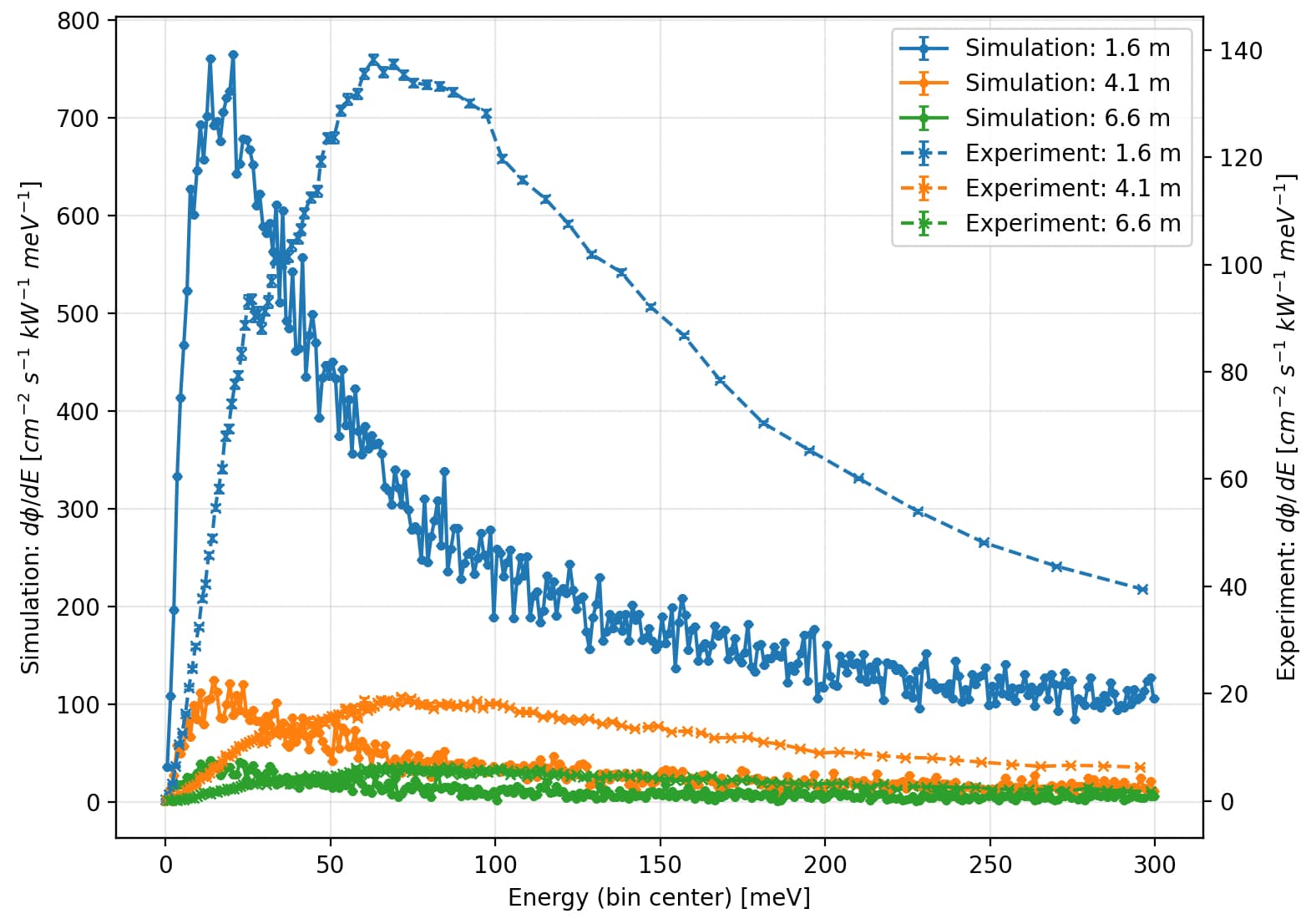
I have undertaken an experiment (in the CLEAR facility at CERN) to measure the thermal neutron flux produced by 40 MeV electron beam striking a bespoke target-moderator-reflector assembly, and I have been given the corresponding FLUKA results for simulating the same setup. I want to compare the results between simulation and experiment by plotting energy vs differential flux in units of [neutron/s/cm^2/kW]. I would really appreciate help to check that I am processing the FLUKA results correctly…
In processing the experiment data, we calculate the ‘differential flux’ as:
Differential flux [neutrons/cm^2/kW/s/meV] = Counts [neutrons] / A_detector [cm^2] / E_target [kJ = kW x s] / detector_efficiency / ∆E [meV],
where Counts is the number of counts (neutrons) measured by the detector in each energy bin, A_detector is the area of the detector (equal to 73.0 cm^2), E_target is the amount of energy delivered to the target in the measurement time (equivalent to the average beam power times the measurement time), the detector efficiency is the energy dependent detector efficiency, and ∆E is the channel bin width.
I have been passed FLUKA results as sum.lis and tab.lis files. I believe that the tab.lis returns:
dN/dE [neutrons/GeV/cm^2/pr]
(The simulation includes biasing / scoring factor, given in the sum.lis as W = 3.51e-8 [Part/pr = neutrons/pr]. But I believe this is already incorporated in the value above so I don’t need to use it.)
By taking there to be N_e = 1.56e14 [pr/s/kW] electrons of energy 40 MeV per kW of beam power, then the ‘differential flux’ measurement is calculated as:
Differential flux [neutrons/cm^2/kW/s/meV] = dN/dE [neutrons/GeV/cm^2/pr] x N_e [pr/s/kW] / 1e12 [GeV/meV].
I include the comparison of the plots below. As you can see, there are discrepancies! But, for the purposes of this question, can I please check that the FLUKA results are being processed correctly (particularly that I don’t need to account for the scoring factor)?
Cheers,
Laurence
