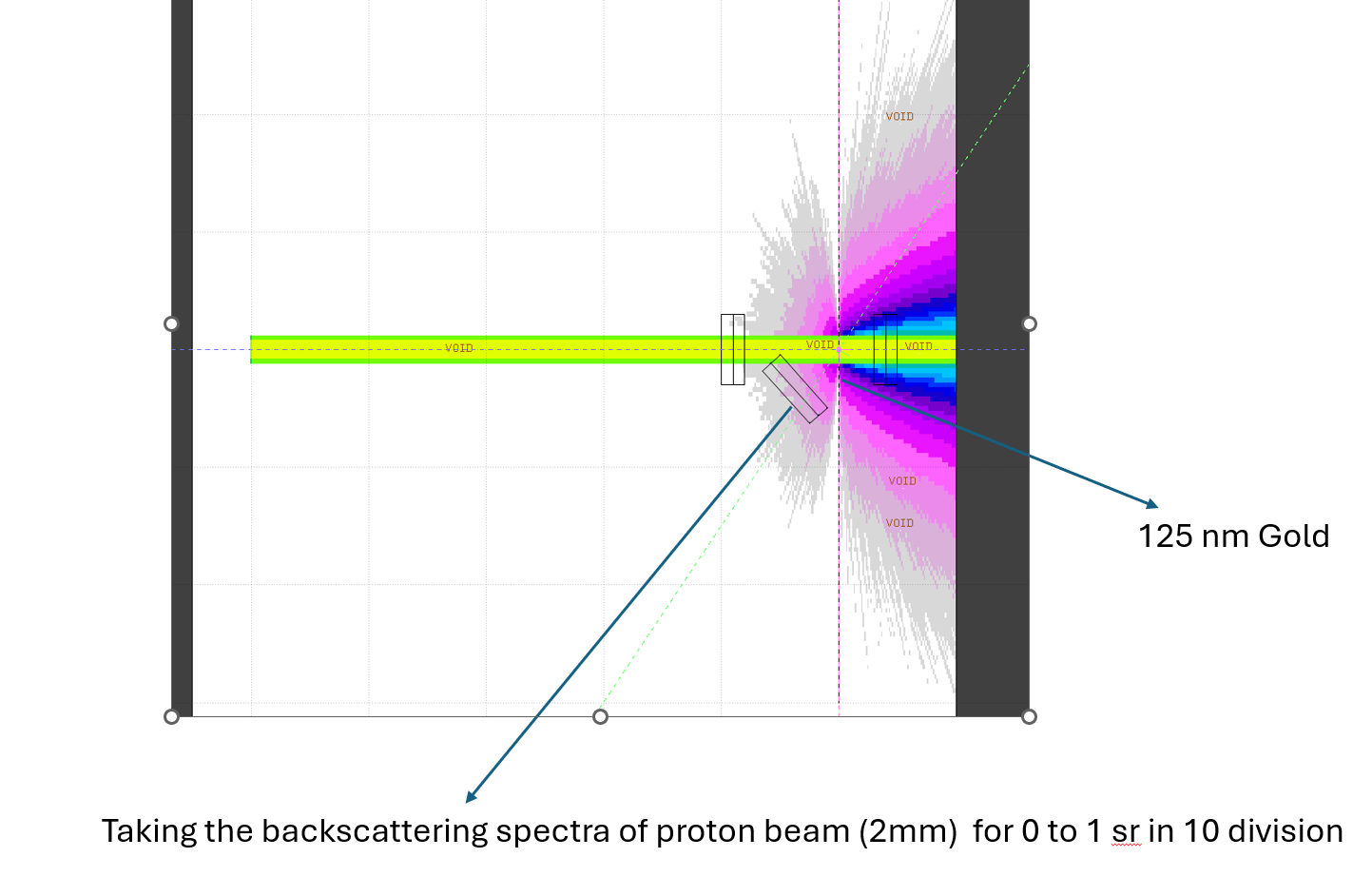
I am interested in studying the backscattering spectrum of particles from a 125 nm gold foil. In my simulation, I send a 1 MeV proton beam onto the target and use USRBDX to score particles in the solid angle range of 0 to 1 sr with 0.1 sr intervals around the 138° plane. Later, I extrapolate this spectrum (using spline interpolation) to match the solid angle of my detector, which is quite small (~0.0001 sr).
However, in this way I obtain very poor statistics for the backscattered particles, giving values on the order of ~1×10⁻¹¹ particles, whereas theoretical estimates suggest it should be closer to ~1×10⁻⁹. I understand that this is mainly due to limited statistics. Currently, I am using 1×10⁸ primary particles, but theoretically this would imply that only about one particle would be backscattered within that small solid angle if I simulated 1×10⁹ primaries. Therefore, to achieve reasonable statistics, I would likely need at least ~1×10¹¹ primary particles, which could require weeks of computation time.
I also tried using the LAM-BIAS card, although I understand that it mainly affects weighting rather than increasing the number of events in the region of interest, so the final result remains essentially the same.
For context, I use the extrapolated spectrum from this first simulation as the source for a second simulation to calculate the energy deposition in my detector. This two-step approach was intended to avoid poor statistics in the detector stage, but unfortunately the first step still suffers from insufficient statistics.
Could you please advise if there is a better approach or any variance reduction technique that could help improve the statistics for this type of backscattering simulation?
The low statistics you are observing is indeed consistent with the underlying physics of your problem.
Since 1 MeV protons on Au are below Coulomb barrier, we don’t expect nuclear interactions: the LAM-BIAS card in your input is therefore not effective in your case, since it affects nuclear inelastic interactions. The proton backscattering you’re interested in should be due to Coulomb scattering.
To sufficiently decent approximation, you may take a simple Rutherford differential cross section (DCS) for Coulomb scattering of 1 MeV protons on Au. Considering that this DCS strongly forward-peaked, the large-angle deflections (like ~138°) you care about have ridiculously small probabilities of taking place. This explains the low statistics you experience in your simulation.
Presumably you’ve already evaluated the cross section (in mb) for the events you care about, i.e. the integral of the aforementioned Rutherford dcs over the solid angle subtended by your detector at large backscattering angles. If not, we can provide you further pointers. You can therefore evaluate the mean free path (lambda) for your 1 MeV proton to undergo a Coulomb collision in the backscattering domain you care about. And you can immediately invoke Poisson statistics to evaluate the likelihood for an incoming proton to undergo one such collision in your dz=125 nm slab: P=(dz/lambda) exp(-dz/lambda). You can likewise check that the likelihood of plural Coulomb scattering within the terribly thin slab such that ultimately protons make it back into the detector is negligible in comparison.
If so, your best course of action is most likely to run a FLUKA simulation with an extended proton beam starting on the surface (nudged a bit into the vacuum side to avoid numerical geometry issues) pointing towards the detector, with the right opening such as to cover its full solid angle. All simulation results you’d obtain you’d naturally have to interpret as “per backscattered proton”. You then carefully scale things back to “per incoming proton” invoking P above.
Hope this helps,
Giuseppe
PS: in future releases of the code (a few years from now), a revised charged-particle transport algorithm will be introduced with the capability of biasing large-angle Coulomb scattering.
PS2: in the argument above one disregards the effect of energy loss through electronic stopping (should amount to about 15 keV).