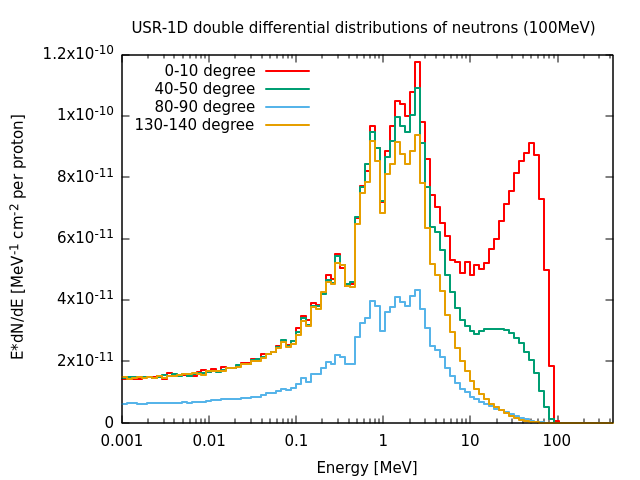
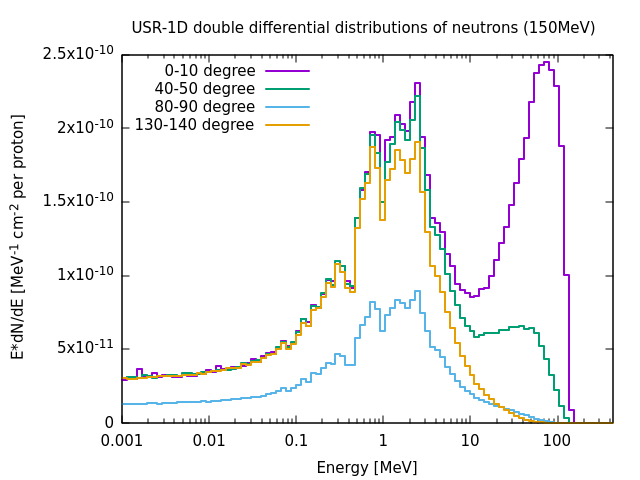
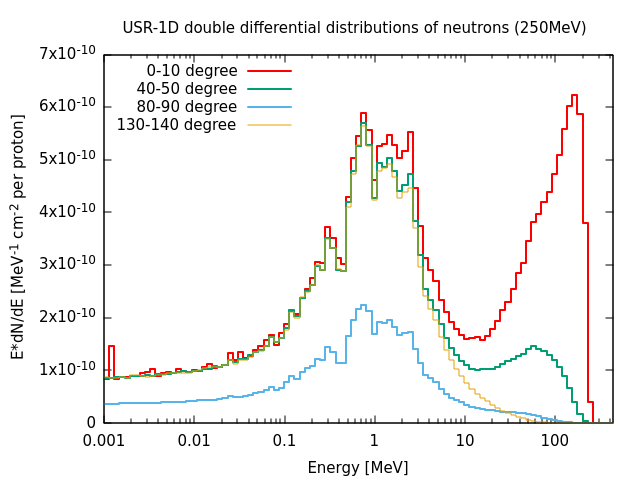
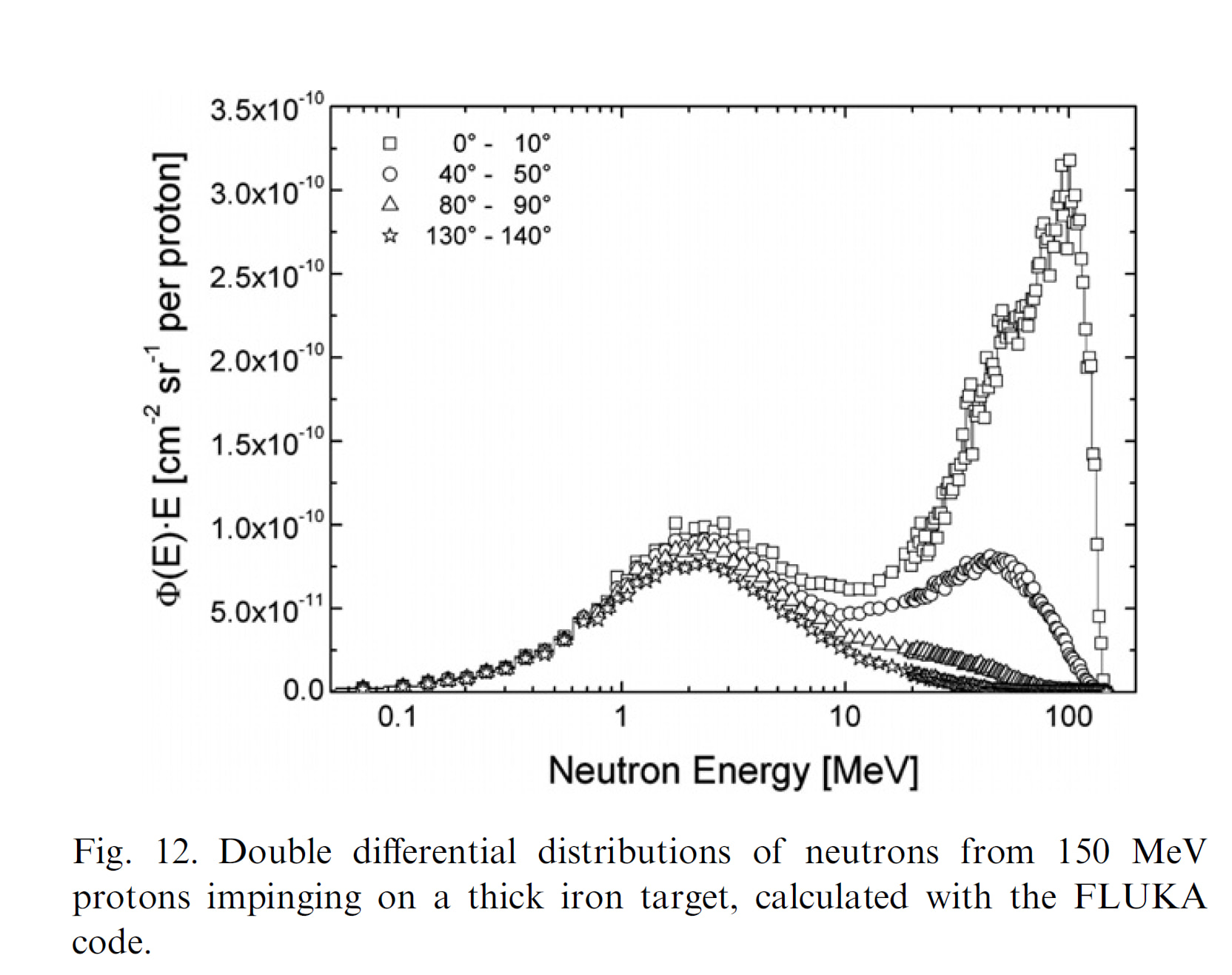
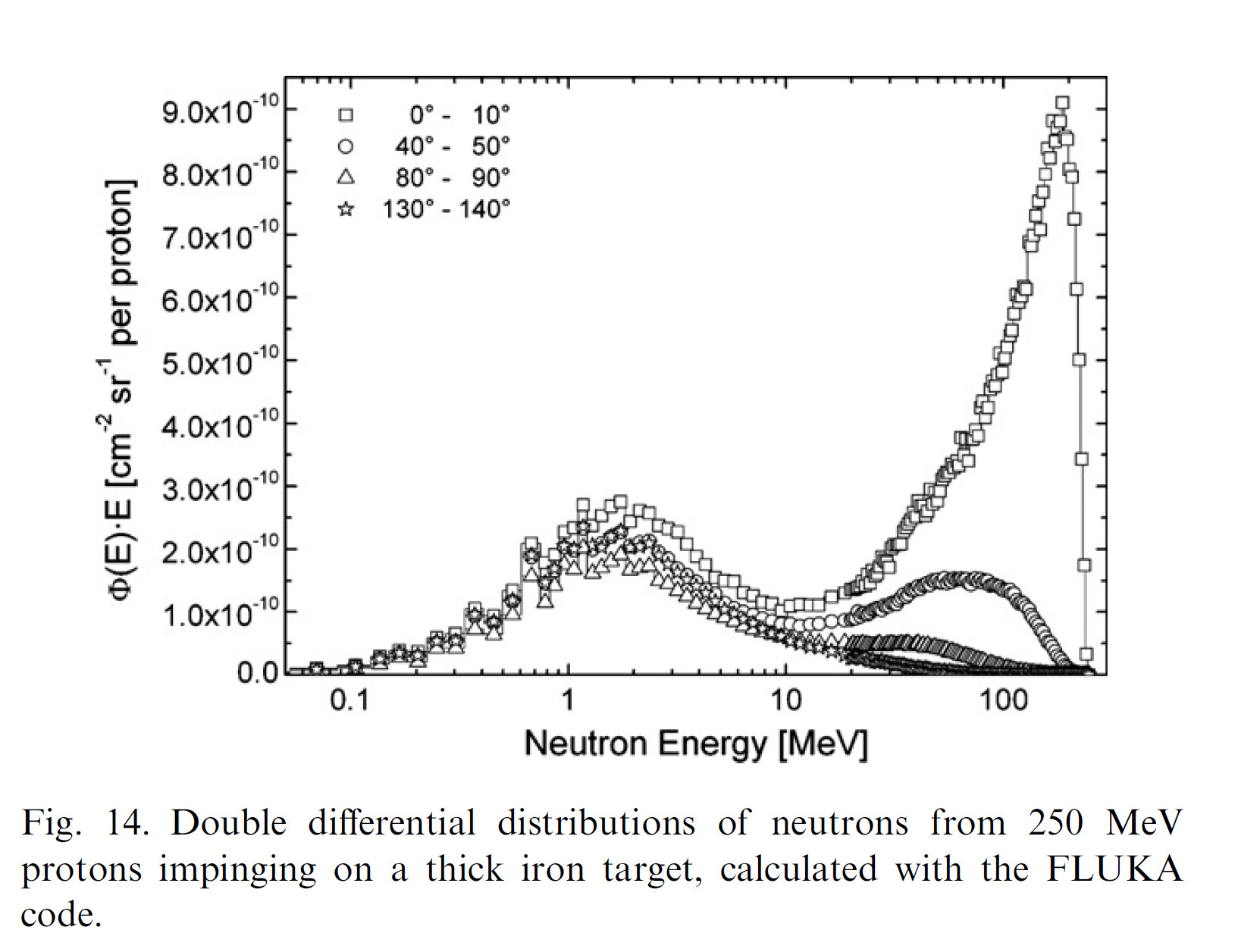
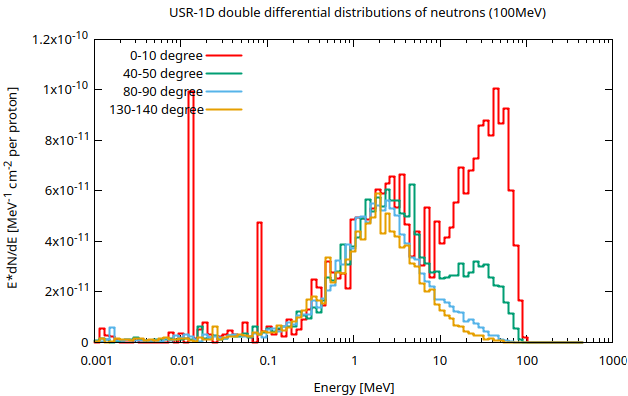
I hope this message finds you well. I had a question regarding doubel differential distributions of neutrons from 100 - 250 MeV protons impinging on a thick iron target. Based on the method discribed in the S. Agosteo et al. article (Redirecting), I resonstructed the FLUKA input file for calculating the neutron energy spectrum. However, I was unable to reproduce the results from the literature.
I have attached my input files and simulation results.
Thank you very much for your time in advance. Any help would be appreciated!
Best regards,
Chuanye
Input files
Please upload all relevant files. (FLUKA input file, Flair project file, user routines, and data files)
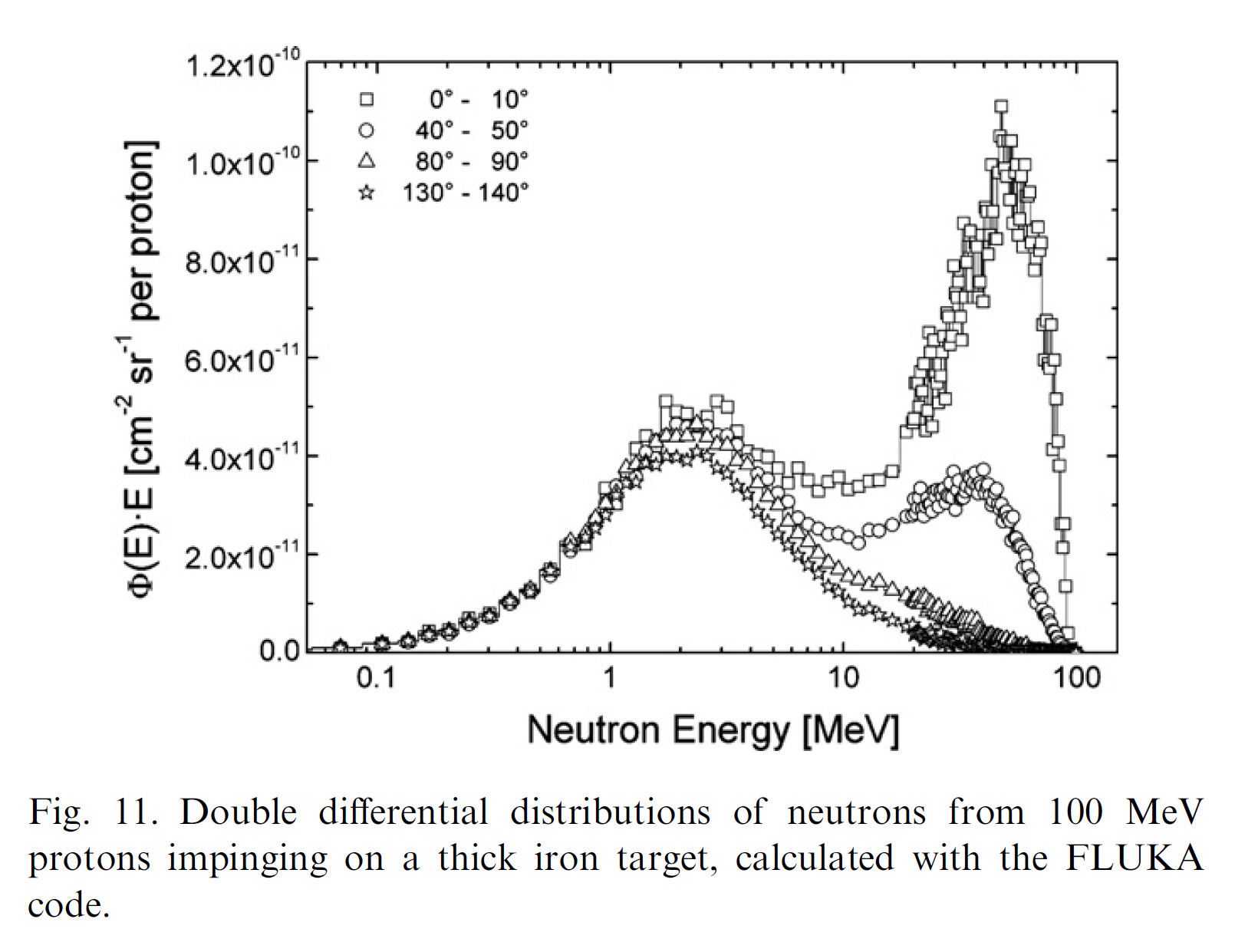
As a comparison, I uploaded the results from the literature. The main differences between my simulation results and those in the references can be observed.
At small forward angles (0-10 degrees), my simulation results did not show high-energy cascade neutron peaks.
The evaporation neutron peaks in all simulation results were higher than those in the references.
I don’t know if the problem lies with my geometry settings or my physics settings.
Your figures above patently contradict this statement.
This is because, contrary to the paper authors, you did not set to blackhole the concrete shell outside the scoring regions, and thereby you got the contribution of the neutrons reflected by it.
Also, note that the unit you indicated on the vertical axis is wrong, since the plotted quantity is not expressed in MeV^{-1}, because of the multiplication by the energy implied by the lethargy representation.
Thank you very much for your answer and suggestions.
I have adjusted the model based on your and @Long Wang’s suggestions and obtained results consistent with the literature.
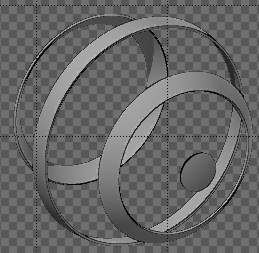
In addition, I further adjusted the model settings to simulate the neutron energy distribution across the entire angle (0-180 degrees, 10-degree step). First, I set the spherical surface centered on the target to a vacuum of 0.1 cm to completely avoid the influence of scattering on the neutron flux. Then, I use planes to divide the spherical shell into 18 regions.
At the same time, the inner diameter of the spherical shell was changed to 100cm (90m in the original article was for the purpose of shielding attenuation research). I believe these settings and adjustments meet my research needs and are correct.