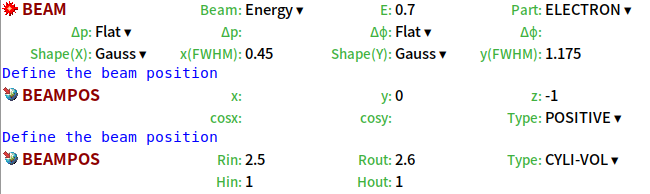
Dear FLUKA experts, I have a beam that sweeps around a circle, and the beam spot follows a Gaussian distribution. I want to calculate the energy deposition for the subsequent thermal safety analysis. May I ask if this definition of beam current is appropriate? The sweep radius is 2.5cm.
thanks for your question. To me, it looks like the definition of your sweeping beam is correct if your goal is to simulate a Gaussian beam spot sweeping along a circle with a radius of 2.5 cm. Your implementation using two BEAMSPOT cards seems to be an appropriate choice for this problem (Slides of the latest FLUKA beginners course: Sources & Pre-processors), especially if you are interested in the time-averaged effect of the beam.
A user-written source would become necessary if the sweep geometry is more complex, or if you are interested in the time-dependent energy deposition rather than the time-averaged effect.
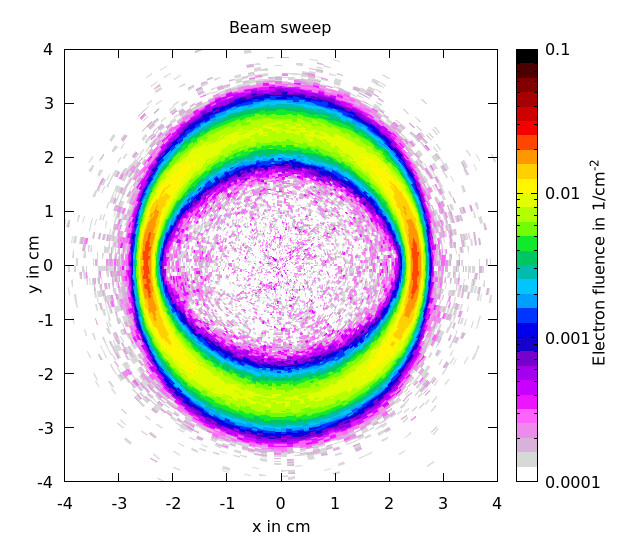
If you are unsure whether your implementation behaves as intended, it can be helpful to set up a USRBIN scoring the ELECTRON fluence and visually inspect whether the beam profile and sweep match your expectations.
FLUKA provides energy deposition in units of GeV/cm³ per primary. Since you plan to perform a thermal safety analysis, you will need to convert the results to joules and scale them according to your beam current and time of operation.
If you have any further questions, feel free to upload your input file.
Thank you for your patient assistance. I have carefully understood the solution you provided, but I still have two questions. The first one is, how to define time-dependent energy deposition? As I understand, it seems that fluka cannot consider time effects. I wrote a source.f program, but it seems to only achieve the average value after scanning, and the scanning process cannot be simulated. The second question is, how should Rin and Rout be appropriately selected using the method I mentioned above? A difference of 1mm between the two should be sufficiently conservative, but will it not reflect the Gaussian distribution because 1mm is much smaller than the half-width of the beam spot.
thanks for providing your source routine. I think this is the correct way to go for your case.
To answer your second question first: if you work with the BEAMPOS card using CYLI-VOL, the starting positions are sampled uniformly in the region between Rin and Rout. This does not represent a Gaussian beam spot, so for a Gaussian spot sweeping along a circle your user-written source is the recommended approach.
I had a look at your routine and it looks quite good. Just a few remarks:
You define particle_code = 1 (protons). If you want to simulate electrons, please make sure the particle type in the source routine is set accordingly (electron), or remove this line if it is not used.
You define momentum_energy = 700.0D0. If you want to simulate 700 MeV, this should be 0.7D0, since FLUKA expects energies in GeV in this context.
In the line where you calculate the angle, FLRNDM requires a dummy argument to work. A possible solution could be to use FLRNDM(xdummy) and first assign xdummy a value.
With these adjustments you should obtain the beam profile you are aiming for.
You are also correct that FLUKA does not consider time effects in the sense of simulating temperature evolution in the material. In principle you can introduce a scan phase / time variable at the level of the source routine to represent the sweep pattern, but extracting the time-resolved deposition then requires more advanced scoring and post-processing. Personally, I would only go down that route if the relevant thermal response time is comparable to or shorter than the sweep period; otherwise the time-averaged deposition is typically sufficient.