Versions
Please provide the used software versions.
FLUKA: 4-5.1
Flair: 3.4-5.2
Operating system: Ubuntu on Windows Subsystem for Linux
Compiler: GNU Fortran (Ubuntu 13.3.0-6ubuntu2~24.04.1) 13.3.0
Description
Hello, I am trying to incorporate specular reflecting boundary conditions to a micron scale geometry. I have been adapting Dávid Horváth’s usrmed.f script for neutron reflections to my purposes.
The geometry consists of a square region, CELLVOID, filled with 200 smaller cylinders (on the order of micron diameter). Collectively, we’ll refer to the CELLVOID and tungsten cylinders (named F01Y0101 to F01X1010) as the simulation “cell”. This cell is illuminated by a 440 GeV/c proton beam in the z direction, which has a uniform square shape with width about half that of the cell’s transverse directions.
The cell is contained in a sphere (the blackhole region), with an upstream and downstream part delineated by the faces ±z faces of the cubic cell. Between the ±z faces of the cell, the region outside the cell, extending in the X,Y directions is called the “boundary”. The idea is that any neutrons produced by interactions of the proton beam with the cylinders in the cell would be reflected back into the cell as soon as they tried to cross into the boundary region. In this way, the neutrons would only be able to exit downstream or upstream.
…Long story short, I’ve been having a lot of trouble with getting this to work perfectly. It seems that, somehow, a neutron is able to escape into the boundary region sometimes, and perhaps more strangely, will even have a step in the boundary region, whose material is vacuum. We’d expect the neutron to be transported directly to the bounding sphere of blackhole (correct me if I’m wrong on that part, but in any case, the neutron escaping into the boundary mysteriously is the bigger problem for me). I’ve made lots of edits and added bits to debug the usrmed.f script, as you can see, but I can’t seem to identify where the single escaping neutron is coming from, and I figured it would be good to ask for help at this point.
STEPSIZE is already set to be much lower than the problem dimensions, and the upstream and downstream regions (except for a small “vestibule” upstream for the primary proton beam) have their material set to blackhole so it can’t be making it way in by somehow scattering off something else. The script is set to reflect the neutron if it is coming from any of the regions directly in contact with the boundary region. I’ve also debugged by having USRMED raise errors in various cases to try to tell me where this neutron is coming from, but I can’t seem to catch it before it escapes and raises the MREG=NEWREG=BOUNDARY issue.
To replicate the problem: use the errorReport.flair file attached (the other .flair is just geometry). Compile a custom exe with usrmed_reflect.f (attached), and spawn 4 cores and run for at least 20,000 histories (or just use what is entered in the .flair project currently as the default run). The second spawn should crash and print the following in the .log file:
ERROR, Current Region is: 4
X,Y,Z = 3.3279637819895939E-003 -2.8039045997420905E-003 2.6820878649234598E-003TX,TY,TZ = 0.48656139870009008 -0.86797836181848853 -9.9355768377609191E-002
STOP MREG and NEWREG equal in vacuum region
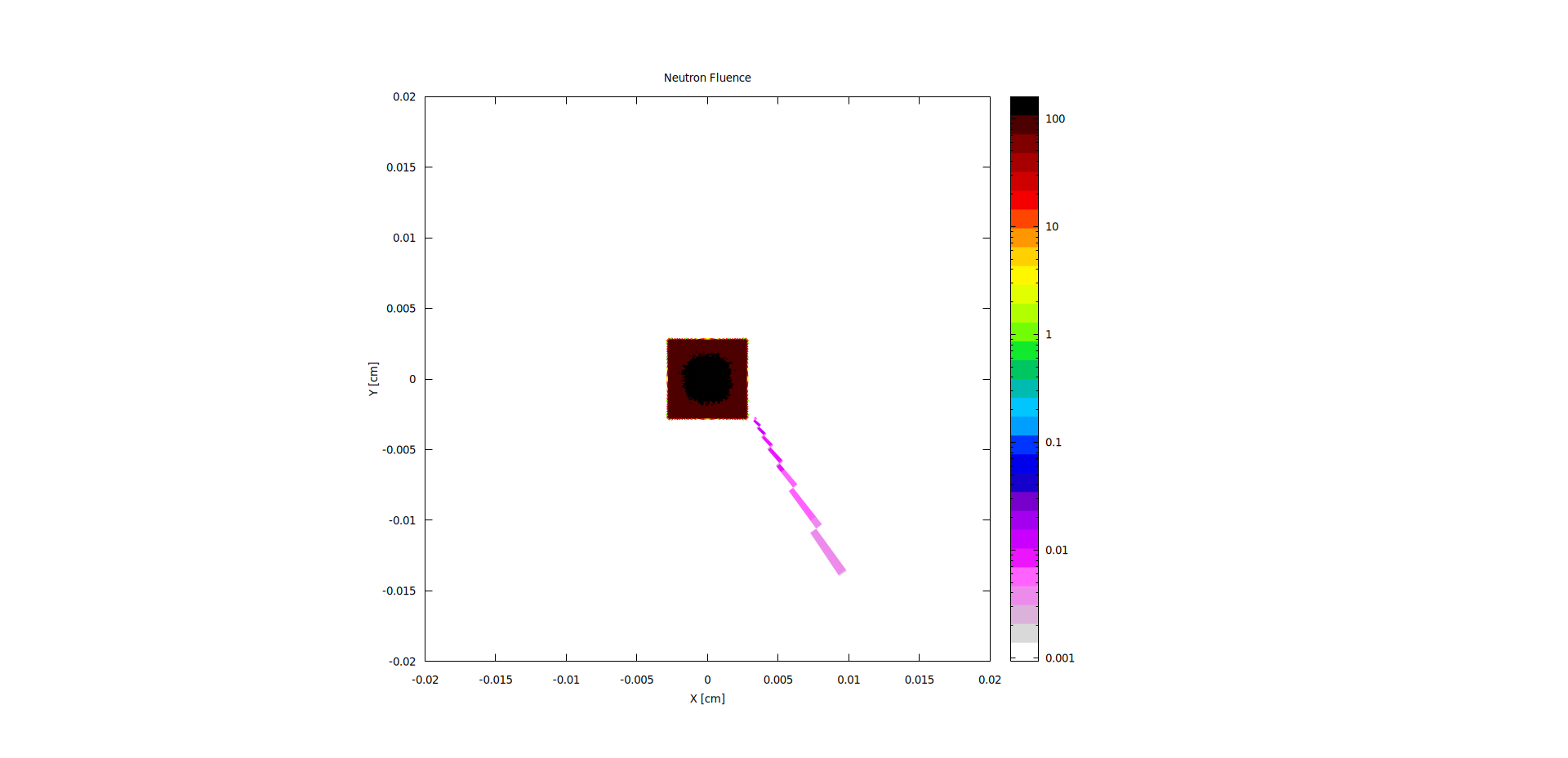
…With region 4 being the boundary region that has the reflection imposed by MATPROP and usrmed_reflect.f (and again, the material of that reguin is vacuum). The attached image, “escapedNeutron.png”, shows a cylindrical usrbin of neutron fluence that shows the simulation cell full of neutrons, but with a single neutron escaping into the boundary region. I’m trying to prevent that last part! The neutrons should only be able to escape upstream or downstream, ideally.
Input files
Please upload all relevant files. (FLUKA input file, Flair project file, user routines, and data files)
errorReport.flair → flair project that has all supporting cards for setting up the simulation
geometry.flair → just read for the simulation cell geometry (it’s generated by a python script, too monotonous to build by hand)
usrmed_reflect.f → the user routine that tries to make all neutrons reflect specularly if they try to escape the simulation cell in the X,Y directions. It’s a terribly mangled version of Dávid Horváth’s script for a neutron reflector, in short!
Thanks very much for your time and help, and hopefully I’m just overlooking something!
–Will
usrmed_reflect.f (4.9 KB)
geometry.flair (38.5 KB)
errorReport.flair (2.6 KB)
