Version
FLUKA:4-5.1
Flair:3.4-5.4
Description
Hello FLUKA Experts,
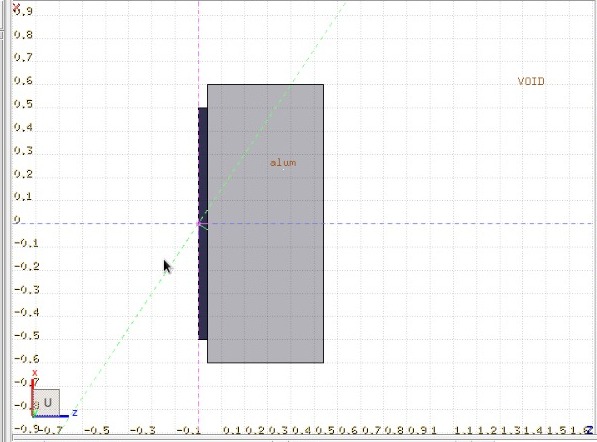
I am setting up a simulation for a 30 MeV proton beam impinging on a geometry consisting of two thin cylinders aligned back-to-back along the beam axis (the first cylinder is the target, and the second is the substrate). Please note that the target and the substrate are assigned to different materials.
Currently, the end surface of the target and the starting surface of the substrate touch each other exactly. When inspecting the geometry or running Flair, I receive a warning regarding these touching bodies.
From a computational efficiency and tracking accuracy perspective, I would like to know:
Is there a significant performance penalty or risk of tracking errors (such as precision round-off issues) when leaving these two cylinder bodies exactly touching, especially considering the material boundary?
Alternatively, would introducing a microscopic gap (e.g., \(10^{-3}\) cm of VACUUM) between them avoid the warning without significantly impacting the proton energy deposition (\(dE/dx\)) and computational overhead?
What is the recommended FLUKA best practice to model this interface? Should I instead define a single infinite cylinder (
ZCC) and segment it into two regions using a single infinite plane (XYP) to ensure a mathematically perfect boundary between the two different materials?Thank you in advance for your help and guidance!
Best regards