I am just a beginner. I am supervising a graduate student for a research program. The topic is about high-energy electron beam interactions with metal targets. We want to study the photon emission and electron-positron pair production. The most relevant physics is the electromagnetic cascade (shower model) of pair production.
We have strong doubts about one of our FLUKA simulations. The input file is attached. It is for an electron beam interacting with a lead target. The beam is with 1 GeV, 10 micron spot size. The target is very long (273 cm). We set a long target, in order to compare with theory models. According to some latest publications, the pair production should be > 10 per incident electron. However, our result has two issues:
The pair production is very low, < 1 per incident electron.
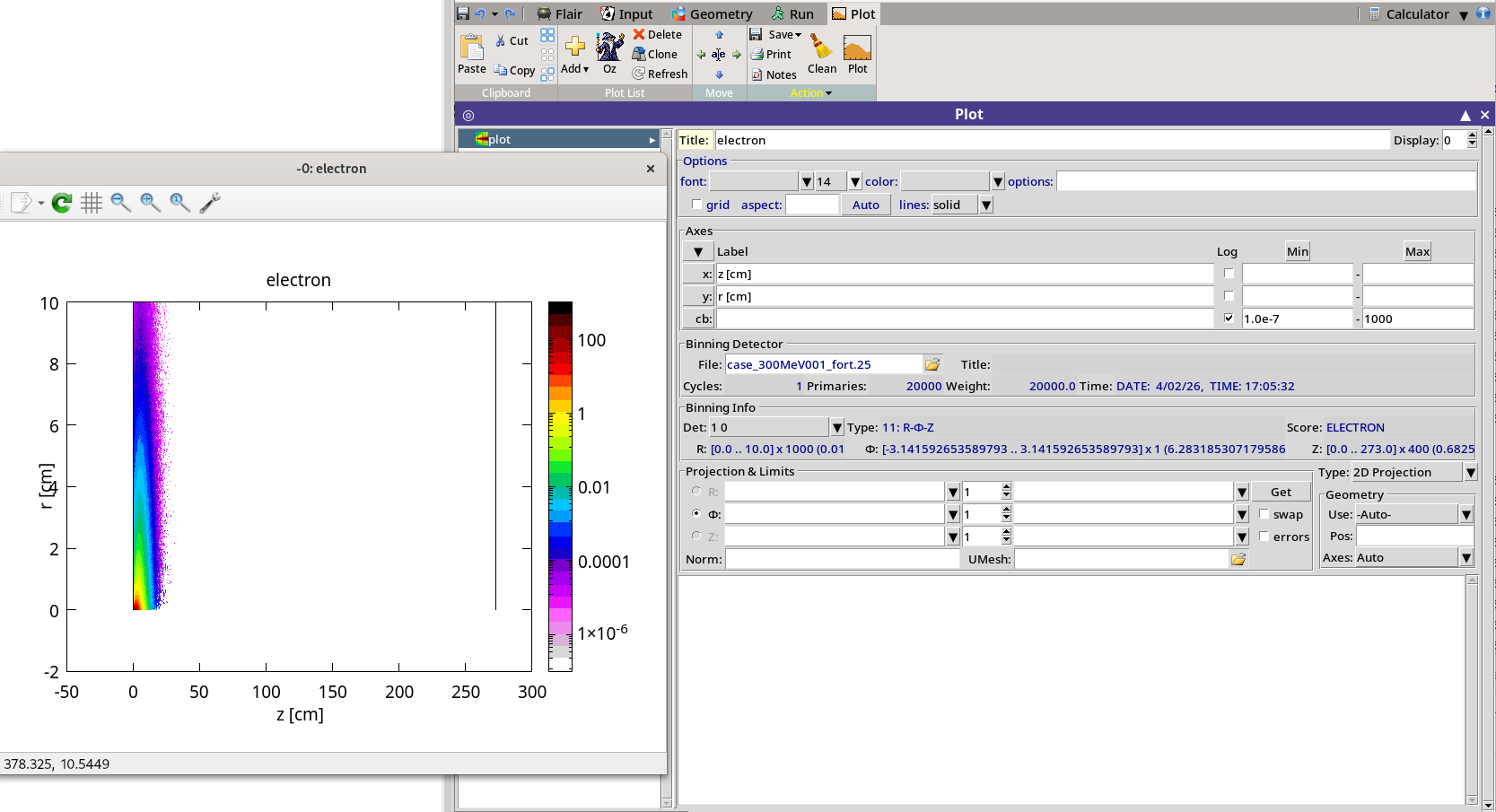
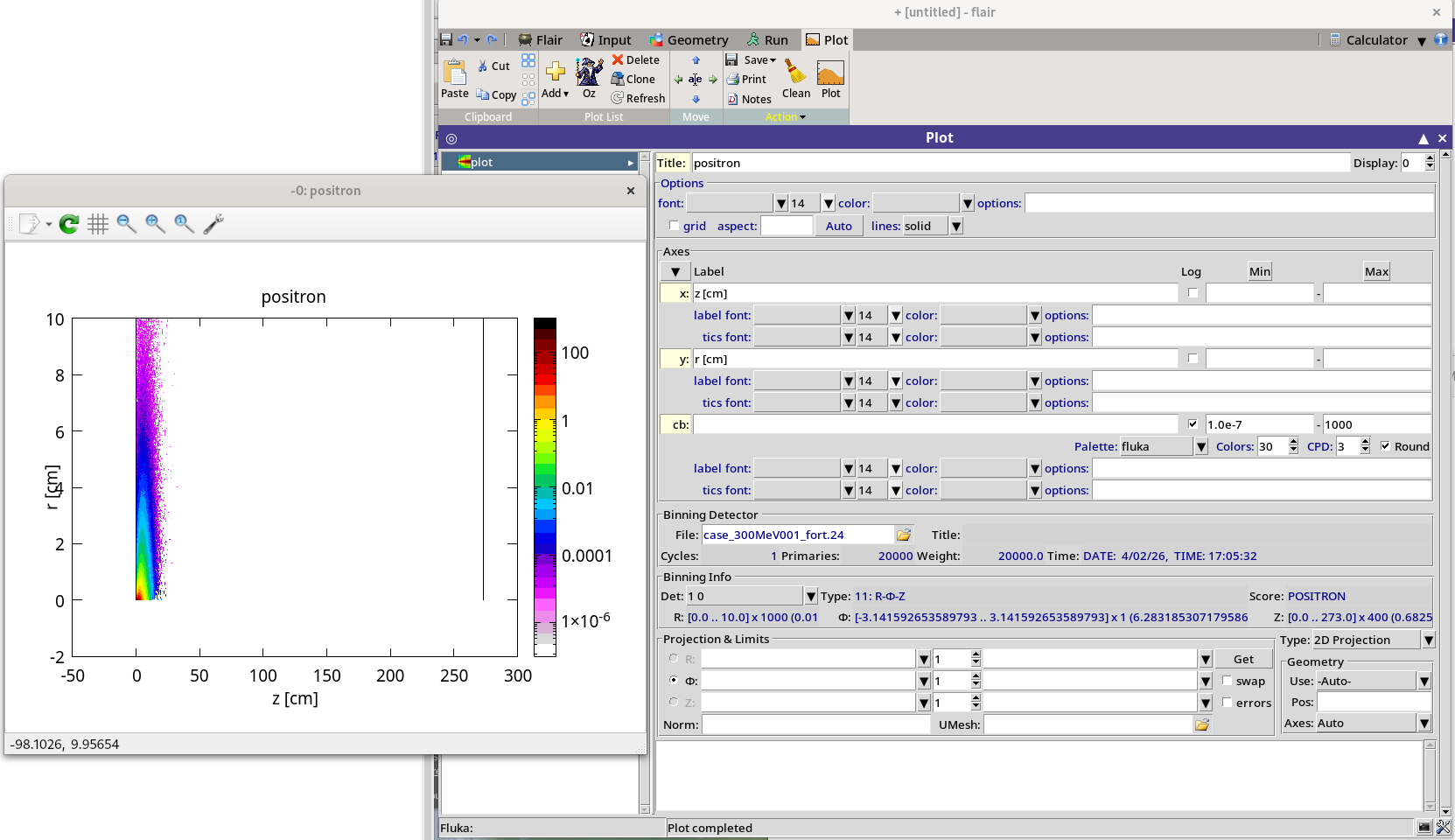
The electron beam, as well as the photons and pairs, undergo severe deflections in the target. They even completely stops at ~25 cm within the target. I don’t know if the deflection and quick termination are correct.
We used USRBIN for detecting photons, positrons, and electrons. The figures for electrons and positrons are attached. We calculate the sum of their respective USRBIN output, and then we infer the ratio between them.
Is our simulation really finished? The beam terminates (stops) quickly at ~25 cm. I suspect that the life time of the particles is not long enough for them to fully pass the long target. Maybe I am very wrong.
Is our methodology correct? We use the sum of USRBIN out, to infer the relative number of particles.
There are 4 columns in the USRBIN out. In the 4th column, the numbers are between 0-100, like a “Weight”. Unfortunately, the simulation on my machine gives all 0. It is non-zero on my student’s computer. Should that weight taken into account when I get the sum of USRBIN?
If I want to know the real number and energy spectrum of the produced pairs, how should I do? USRYIELD or USRBDX?
Should I configure EMFCUT? I actually don’t know what the threshold means in EMFCUT. It means the pair production is not considered for photons with energies below that threshold? I don’t know if I should manually configure them.
Hello,
I am by no means a FLUKA expert, so take everything with a grain of salt.
3. At least for the USRBDX part the 4th column is the relative error in percent.
4. In the past I have also used the DETECT card to measure energy spectra and USRBDX to measure fluences of particles, I am not too familiar with the in general best way to get these.
Thank you for your kind answer. I am happy to know that the 4th column in USRBDX output is the relative error. I think it may represent the same quantity in the USRBIN output.
I think you are right. USRBDX can calculate the fluence spectrum and current spectrum. I am learning it with some materials (powerpoint slides) from FLUKA developers.
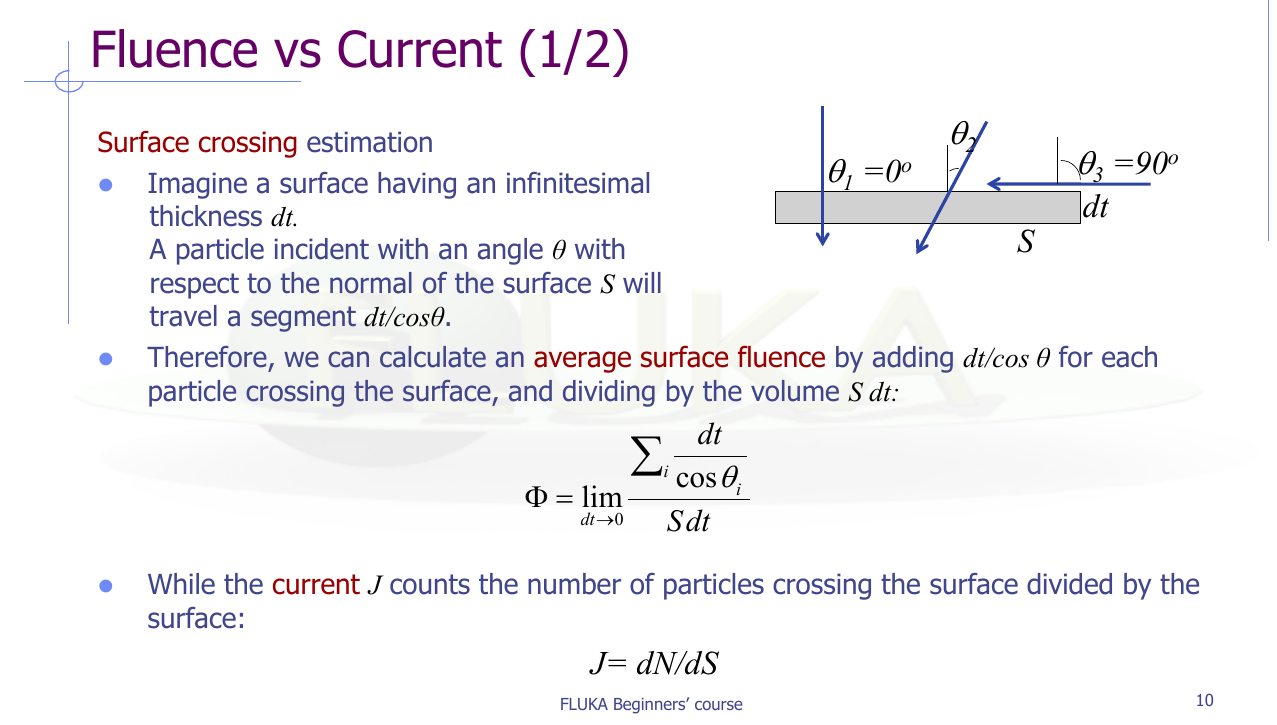
Here, I also have difficulties in understanding the fluence (phi) and current (J) shown in the slides. How does FLUKA deal with the grazing angle (theta = 90)? It is weird, since cos(90) = infinity.
Does dt/cos(theta) here represent the path travelled in the region by the particle under study?
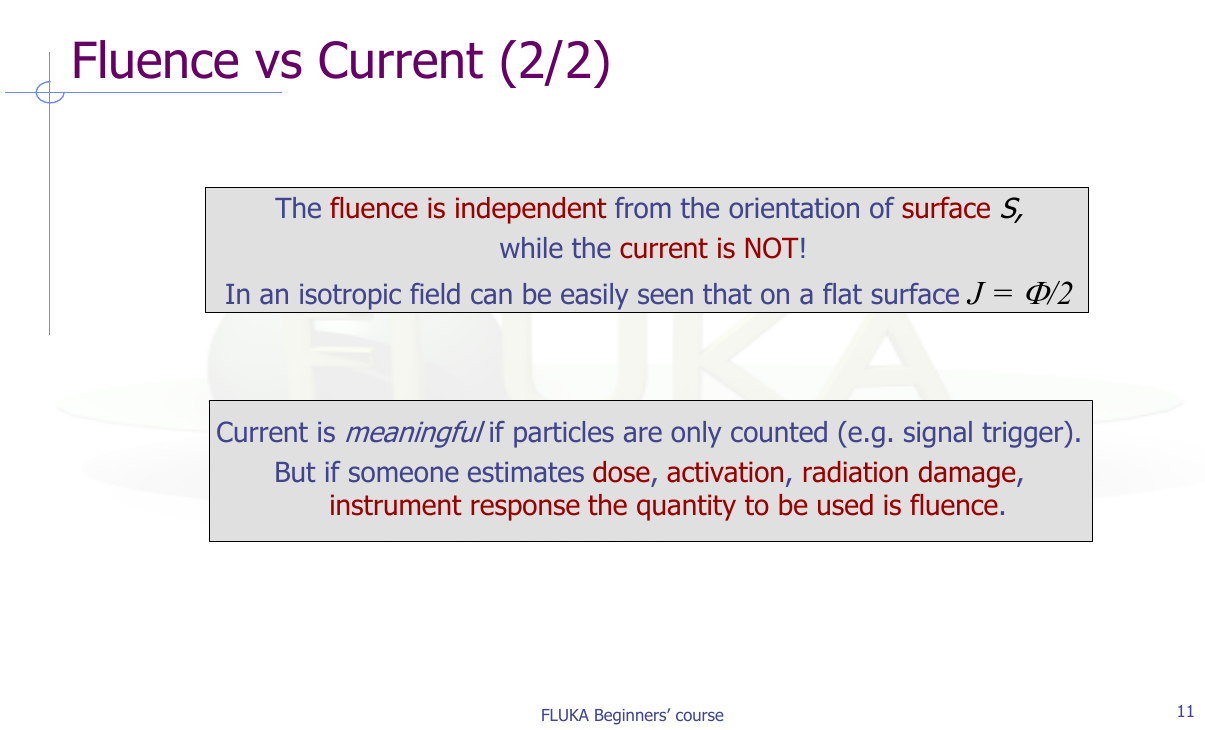
Also, the developers said that J = Phi/2 for isotropic fields. My understanding is that the particles have all incident angles. If one calculate the averaged cos(theta), it is 1/2. Therefore, we have phi = 2*J.
Anyway, I don’t fully get the meanings of J and phi. It seems that J gives the number of particles crossing the surface, and phi takes into account the incident angles (or the path in the region of interest)?
There is nothing particularly wrong with your input file. I’d rather question:
whether you are considering the same geometry/model that is behind the data or theory models you wish to compare to;
whether you are estimating the pair production in the same way as the theory/data (i.e. which scoring you are basing yourself on)
To summarize:
Yes it is correct and not related to the lifetime of the particles. After an initial build-up, the longitudinal development of the EM shower can be described with an exponential attenuation over distance x as e^{-x/X_0},X_0 being the radiation length (which by the way FLUKA prints in the output file for the materials in the input file). So, if you roughly assume a radiation length of 0.56 cm for pure lead, it is no surprise that after 30 cm the fluences drop essentially to zero.
USRBIN is not the correct estimator for the electron-positron pair production. Consider a thick or thin lead target according to the set-up you wish to reproduce and then use USRBDX instead. In the latter case (i.e. target thickness \ll X_0) USRYIELD may also be a valid option.
As correctly said by David, the fourth column of the *dat file is the relative error in %. But do not confuse the the *dat file (which is produced by Flair for plotting purposes) with the USRBIN output (which is instead the *bnn file). It remains true that the fourth column of *.lis files (USRTRACK, USRBDX, USRYIELD) represents the relative error in %.
As said above, I would choose based on your target thickness.
Without issuing the EMFCUT card, you are telling FLUKA to use default values, which you can check in the output file if they are appropriate or not.
Concerning the USRBDX scoring
a particle that is exactly grazing the surface will not cross the boundary (so no numerical issues).
exactly, as you wish, \Phi = 2J or J=\Phi/2.
“It seems that J gives the number of particles crossing the surface, and phi takes into account the incident angles” → Correct
Hi, Davide,
I appreciate your answers.
Thanks for checking my input. I agree with your reasoning. It should be natural that the beam/positron fluences drop to almost zero after multiple radiation lengths. My colleague performed a benchmark simulation using MCNP. His simulation suggested the same feature (electron distribution). I will carefully check if my simulation configuration is exactly the same with the theory model/results I have read.
It’s true that USRBIN is not the correct estimator for pair yield. Yes, I used the *.dat file. The *.dat file was generated by FLAIR when I used it to plot USRBIN. I summed the data (3rd column) in the file and then inferred the relative ratio between positrons and electrons.
Thanks for your suggestion. I am now learning USRBDX and USRYIELD.