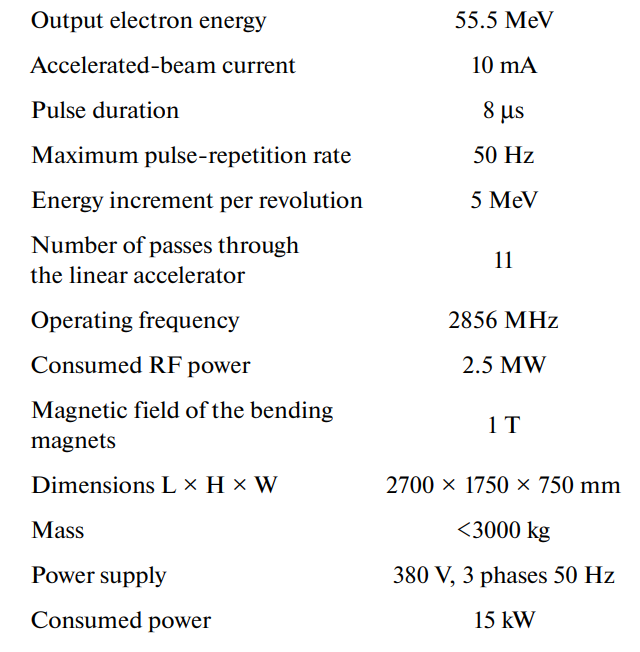
Please I am reaching out to ask how will be a way to implement the pulse duration (8 μs) or maximum pulse-repetition rate (50 Hz) or operating frequency (2856 MHz) for an electron beam coming from an electron accelerator?
That beam having a particles per sec of 3.1E11 and an irradiation time of around 5000 sec.
If implemented conventionally (using cards such as “beampos” and “beam” and “irrprofi“), it is assumed the electrons hit the target continuously. However, that is not the case for an electron accelerator.
I stay tuned, thanks.
Input files
Please upload all relevant files. (FLUKA input file, Flair project file, user routines, and data files)
Which quantities do you want to obtain from the simulation? For most of them, if not all, the time structure you report is irrelevant and shall rather be taken into account at post-processing level, for instance in a subsequent thermo-mechanical simulation.
I am interested on activity yield [Bq] of a radioisotope. I conducted a benchmark and the simulation is still higher than the experiment for that quantity. That number of particles (3.1E11) comes from a current of 51 nA. Perhaps if a formula can be implemented to reduce the number of particles accordingly to the reality for an electron accelerator? Of course, the calculated yield will be lower and near to experimental. Because as it is now, it is being assumed a constant current of electrons on the target container, but actually that is not the reality for an electron accelerator.
Is 51 nA (= 3.19E11 e/s) the average current (equal to the pulse current times the pulse duration divided by the pulse separation time)? If so, the IRRPROFI card should indeed contain 5000 and 3.19E11, being the fine time structure totally irrelevant wrt the radioisotope activity calculation.