FLUKA: 4.5.2 with GNU Fortran (Debian 12.2.0-14) 12.2.0 Flair:none
Description
Hi everyone,
I am currently performing simulations of protons interacting with a natural boron target, with the aim of studying the p–B11 → 3α fusion reaction.
I would like to obtain some information about the cross sections used in the simulations, in particular for the competing B10(p,α)Be7 reaction. I am interested in this reaction in order to compare the simulation results with experimental activation measurements.
Could you please let me know where the cross-section data for the B10(p,α)Be7 reaction are taken from? I would also appreciate any additional information you may have regarding the reaction parametrization, such as the data source, energy range, or any assumptions/models used.
Any references or documentation on this topic would be very helpful.
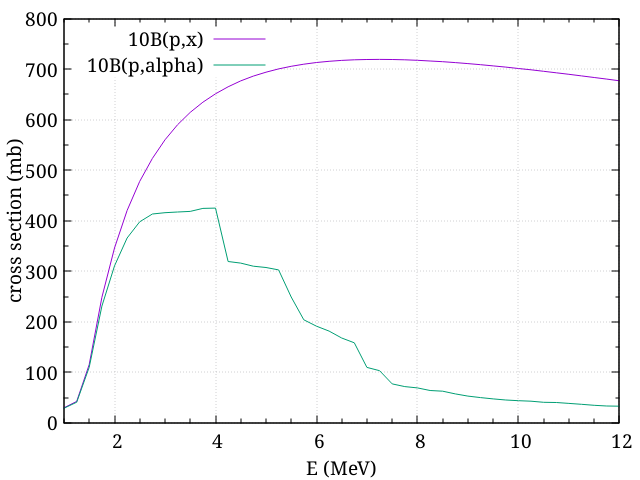
No data are taken, the cross sections of specific reaction channels result from the FLUKA reaction model, while the whole reaction cross section is parametrized, giving the following:
Dear Francesco,
This figure is very helpful for comparing FLUKA with other codes.
I know the reaction cross section can be derived with a very thin target: score the reaction yield, then apply some post-processing.
Is there another way in FLUKA to get the reaction cross sections directly, like the ones in your figure?
for the reaction cross section there is no need for a thin target nor scoring yields and not even running more than one history. One shall just look at the material table in the standard output file and find the desired inelastic scattering length of the primary particle at beam energy. This allows you to calculate the reaction cross section at that energy, via the material density, atomic weight value (g/mol) and Avogadro number.
As for specific channels the reaction cross section is partitioned, then earlier discussions on this forum explained indeed a way to extract it through thin target geometry and yield scoring, recalling however that FLUKA was not conceived as a tool to extract partial cross sections, rather for the calculation of macroscopic yields.