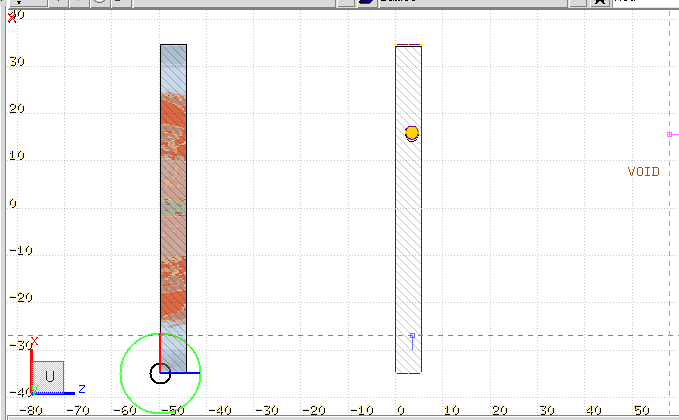
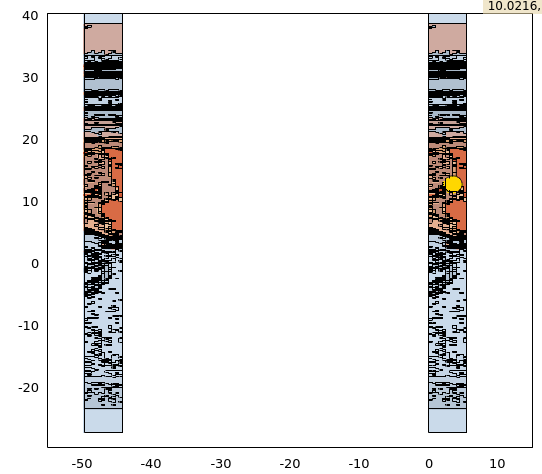
I have a voxelized 3D model. I’d like to insert spherical geometry using an SPH card, which will contain some voxels. Is this possible?
I read in a post from a year ago that it wasn’t easy to do. Has anything changed?
Any suggestions would be very helpful.
Given this limitation, is there any other way to simulate a spherical inclusion within a voxelized volume? Perhaps by post-processing the geometry or using a specific user routine?
There are two ways - one is fast but risky in terms of results (~10 % difference in energy balance is observed against CSG geometry), and the second is more precise, but also more complex.
You can replicate a spherical inclusion by using FLUKA LATTICE functionality, where the replica region contains a void filled with the required material:
You can test it for your case, checking how much it affects the result, when voxels have the same material assigned, against the CSG RPP region with a sphere. NOT RECOMMENDED if precision is necessary.
You should post-process your geometry by converting it into Abaqus mesh format, where each voxel will be represented by a hexahedral element. For your voxel grid of n_x \times n_y \times n_z, the maximum possible number of nodes is (n_x + 1) \times (n_y + 1) \times (n_z + 1). Nodes’ positions must be calculated according to the resolution. The hardest part is splitting voxel groups into regions and associating elements inside with the correct nodes` indices. Thus, after loading this mesh, boolean operations of CSG bodies are allowed with the UMESH cage region. Material assignment should be done manually, unlike for voxels (by means of a script). RECOMMENDED and guaranteed to match CSG equivalent.