Versions
Please provide the used software versions.
FLUKA:4.5.0
Flair:3.4.3
Description
Dear Experts,
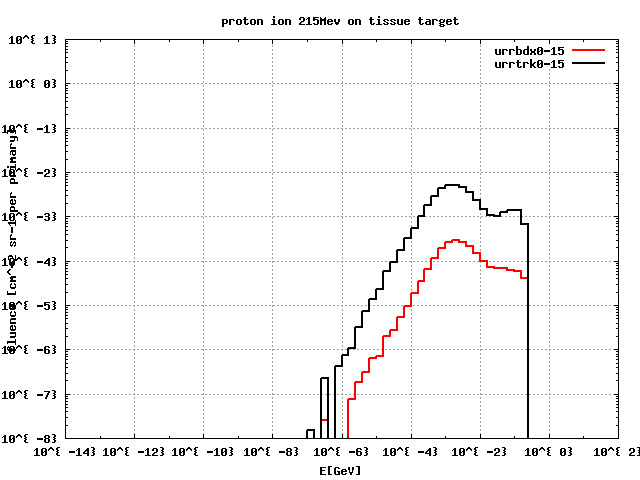
I am currently working on calculating the neutron energy spectra resulting from 215 MeV protons impinging on a iron target. Specifically, I am interested in obtaining the Fluence(cm^-2 sr^-1 per primary) as a function of energy within an angular range of 0–15°.
To achieve this, I am using USRTRACK to score the fluence within the region and USRBDX to score the fluence at boundary. However, the resulting spectra do not show the expected high-energy neutron fluence peak, which is typically observed, as described in Scoring_II_Differential_spectra for forward angle, slide 13. The peak is either missing or significantly suppressed in my results.
I have attached the input file for your reference. I would greatly appreciate any guidance on how to resolve this issue and ensure that the high-energy component is correctly captured.
Thank you for your time and support.
Best regards,
Input files
scoring.inp (1.7 KB)
scoring.flair (1.2 KB)
Please upload all relevant files. (FLUKA input file, Flair project file, user routines, and data files)