Versions
Please provide the used software versions.
FLUKA: 3.4-5.2
Flair:
Description
Hello all,
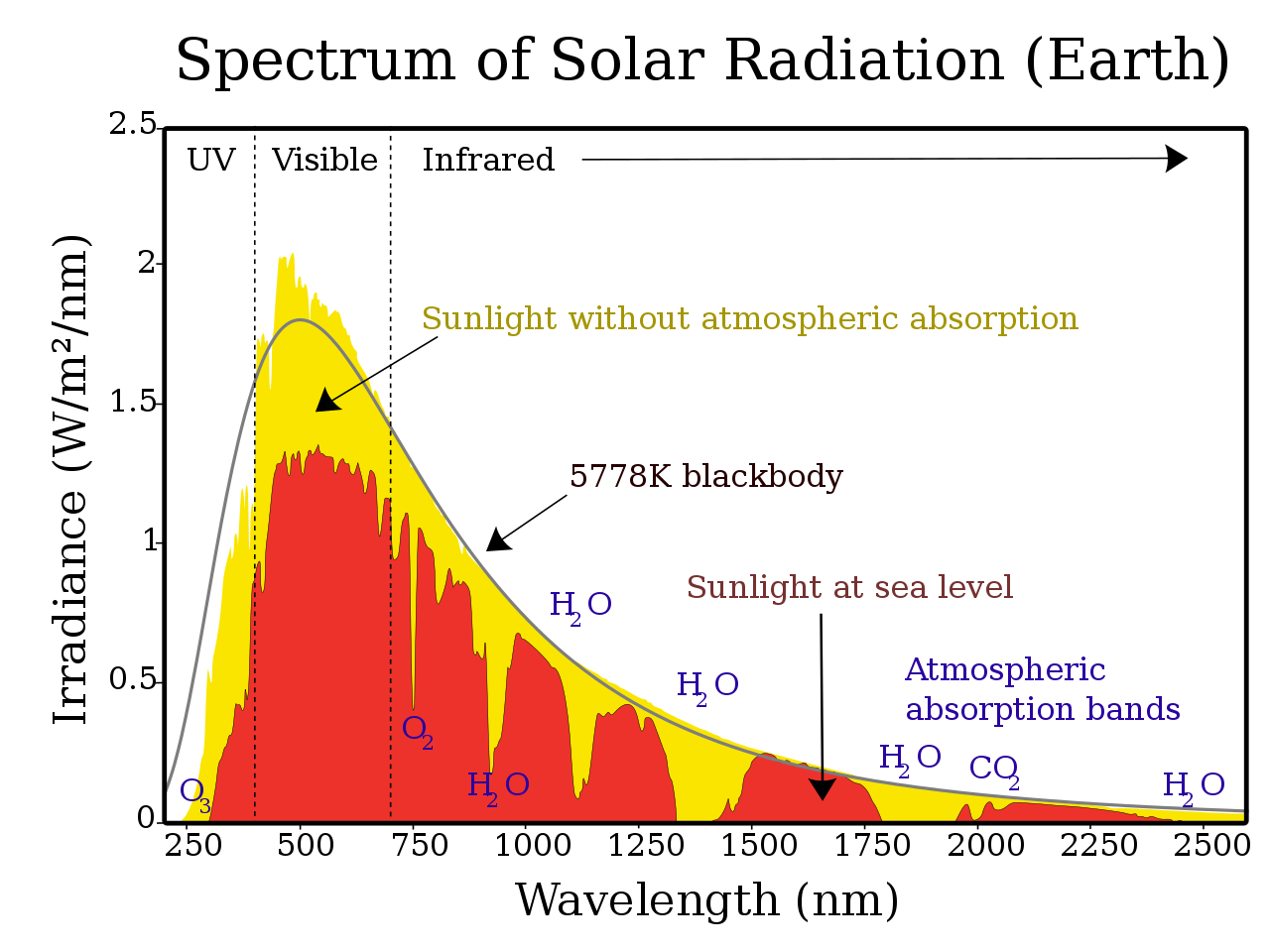
I am trying to model a blackbody emitter in flair and score the photon counts on a detector. I think I’ve got the detector modeling down, but how would I model the source? Lets say I am modeling something like the sun’s emission spectrum seen at sea level, is there a way to properly do this in flair? Or do I need to write a source routine or something like that, if so, could I get some literature on that?
Here’s an image to better visualize what I mean by a blackbody spectrum emitted by the sun. I am trying to emit a large, continuous, spectrum of photons over an area.
(This is to measure UV photons of a specific range for a senior capstone project for background on a detector)
Any help is appreciated! The attached input file is our simulated thorium source and the UV-fluorescence it causes being measured by some PMTs at varying distances, if theres any improvements I can make there let me know!
Please describe the issue. In case of reporting a bug, please provide step-by-step instructions for reproducing the error.
Input files
Please upload all relevant files. (FLUKA input file, Flair project file, user routines, and data files)
ButtonTH-230.inp (3.5 KB)