Versions
Please provide the used software versions.
FLUKA:4-5.1
Flair:3.4-3
Operating system: Ubuntu 20.04 LTS
Compiler:
Description
Dear Experts,
I want to sample a spherical source using source.f routine.
My sampling is as below:
CALL RACO(TXX, TYY, TZZ)
R = 2.5D0
XFLK(NPFLKA) = RTXX
YFLK(NPFLKA) = RTYY
ZFLK(NPFLKA) = R*TZZwhen I used the “Ru106_beta_old_format_source.f”, it is compiling correctly. However, when I used this CALL RACO with “source_newgen_annular.f“ it is not compiling and following error message is coming:
- Compiling: /usr/local/fluka/bin/fff source_newgen_annular.f
gfortran -c -I/usr/local/fluka/include -g -cpp -O3 -fd-lines-as-comments -Wall -Waggregate-return -Wcast-align -Wline-truncation -Wno-conversion -Wno-integer-division -Wno-tabs -Wno-unused-dummy-argument -Wno-unused-function -Wno-unused-parameter -Wno-unused-variable -Wsystem-headers -Wuninitialized -Wunused-label -mtune=generic -msse2 -mfpmath=sse -fPIC -fexpensive-optimizations -funroll-loops -fstrength-reduce -fno-automatic -finit-local-zero -ffixed-line-length-132 -fbackslash -funderscoring -frecord-marker=4 -falign-commons -fbacktrace -frange-check -fbounds-check -fdump-core -ftrapping-math -ffpe-trap=invalid,zero,overflow -o source_newgen_annular.o source_newgen_annular.f
source_newgen_annular.f:383:7:383 | R = 2.5D0
| 1
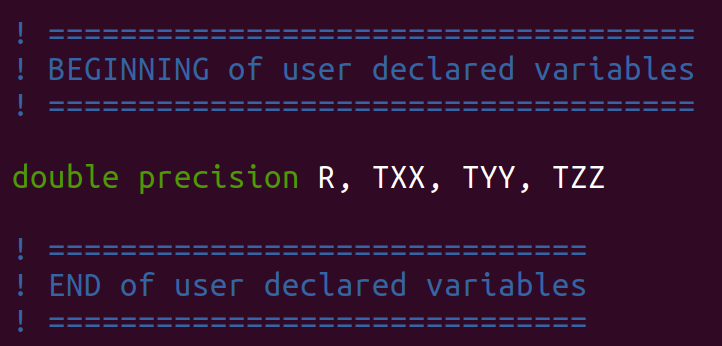
Error: Symbol ‘r’ at (1) has no IMPLICIT type
source_newgen_annular.f:382:19:382 | CALL RACO(TXX, TYY, TZZ)
| 1
Error: Symbol ‘txx’ at (1) has no IMPLICIT type
source_newgen_annular.f:382:24:382 | CALL RACO(TXX, TYY, TZZ)
| 1
Error: Symbol ‘tyy’ at (1) has no IMPLICIT type
source_newgen_annular.f:382:29:382 | CALL RACO(TXX, TYY, TZZ)
| 1
Error: Symbol ‘tzz’ at (1) has no IMPLICIT type
Ended: 2026.02.23 20:55:57Error compiling
Error: compiling file: source_newgen_annular.f
No object generated
see the attached .f files and .dat file
Can you please give me some suggestion on how to use the RACO function with new_gen_source.f ?
Thanking you in advance.
microsphere.inp (813 Bytes)
pure_thermal_neutron.dat (1.9 KB)
Ru106_beta_old_format_source.f (11.5 KB)
source_newgen_annular.f (19.1 KB)
Input files
Please upload all relevant files. (FLUKA input file, Flair project file, user routines, and data files)