Versions
FLUKA: 4.5.1
Flair: 3.4
Description
Dear colleagues,
I’d like to share with you the result for the comparison of the inclusive cross section for the production of charged pions by a 730 MeV/c proton on a thin (1-mm) lead target as predicted by FLUKA with experimental data. Experimental data is obtained from D. R. F. Cochran et al, Phys. Rev. D 6, 3085 (1972) Link
In the simulation, I score the production of all pions in the target by a customized mgdraw.f file, where I modified the USDRAW entry as follows:
   ENTRY USDRAW ( ICODE, MREG, XSCO, YSCO, ZSCO )
      IF (LFIRST) THEN
         LFIRST = .FALSE.
         IF ( KOMPUT .EQ. 2 ) THEN
            FILNAM = '/'//CFDRAW(1:8)//' DUMP A'
         ELSE
            FILNAM = CFDRAW
         END IF
         PRINT *,'ENDRAW ',FILNAM
         CALL MYUSRINI(FILNAM)
c         OPEN ( UNIT = IODRAW, FILE = FILNAM, STATUS = 'NEW', FORM =
c     &          'FORMATTED' )
      END IF

c     Sample PRODUCTION of:
c     pim, pi0, pip
c     photons
c     neutrino
      do ip=1,np
         if ((kpart(ip).eq.5).or.(kpart(ip).eq.6).or.
     &        (kpart(ip).eq.27).or.(kpart(ip).eq.28).or.
     &        (kpart(ip).eq.23).or.(kpart(ip).eq.13).or.
     &        (kpart(ip).eq.14).or.(kpart(ip).eq.7)) then
             CALL saveProd(ncase,kpart(ip),JTRACK,Tki(ip)+AM(kpart(ip)),
     &              Cxr(ip),Cyr(ip),Czr(ip),XSCO,YSCO,ZSCO,ETRACK)
          end if
       end do

* No output by default:
      RETURN
Here, the saveProd function is simply storing all the variables in a ROOT TTree(one entry for each call of saveProd).
To “compute” the FLUKA cross section, I consider, for each energy interval Delta E and cosine interval Delta c_z, the number of events therein Delta N. I am currently setting Delta E=10 MeV and Delta c_z=0.005.
The formula I am using to compute the cross section is:
dsigma/dE dOmega = (Delta N)(Delta E Delta cz ) * 1/(N0 * n * L) * 1/(2pi)
where L=0.1 cm is the target thickness, N0 is the total number of primaries in the simulation, and n=3.3E22/cm3 is the number density of lead atoms. The factor 2pi is to properly normalize the solid angle.
I’d like to share with you the results, to possibly get a feedback regarding the quality of the agreement.
I report the results in terms of the differential cross section as a function of the pion kinetic energy, for different values of the angle. An example is show in the following plot, for the pi+ production at an angle of 15 degrees. The data is reported as the white markers, while FLUKA results are in black / red. The black histogram is obtained from a fully analogue simulation (no bias at all), while the red is obtained from a simulation in which the interaction length of protons in the target is enhanced by a factor 10 via the LAM-BIAScard – in this case, the counts are scaled accordingly when computing the cross section.
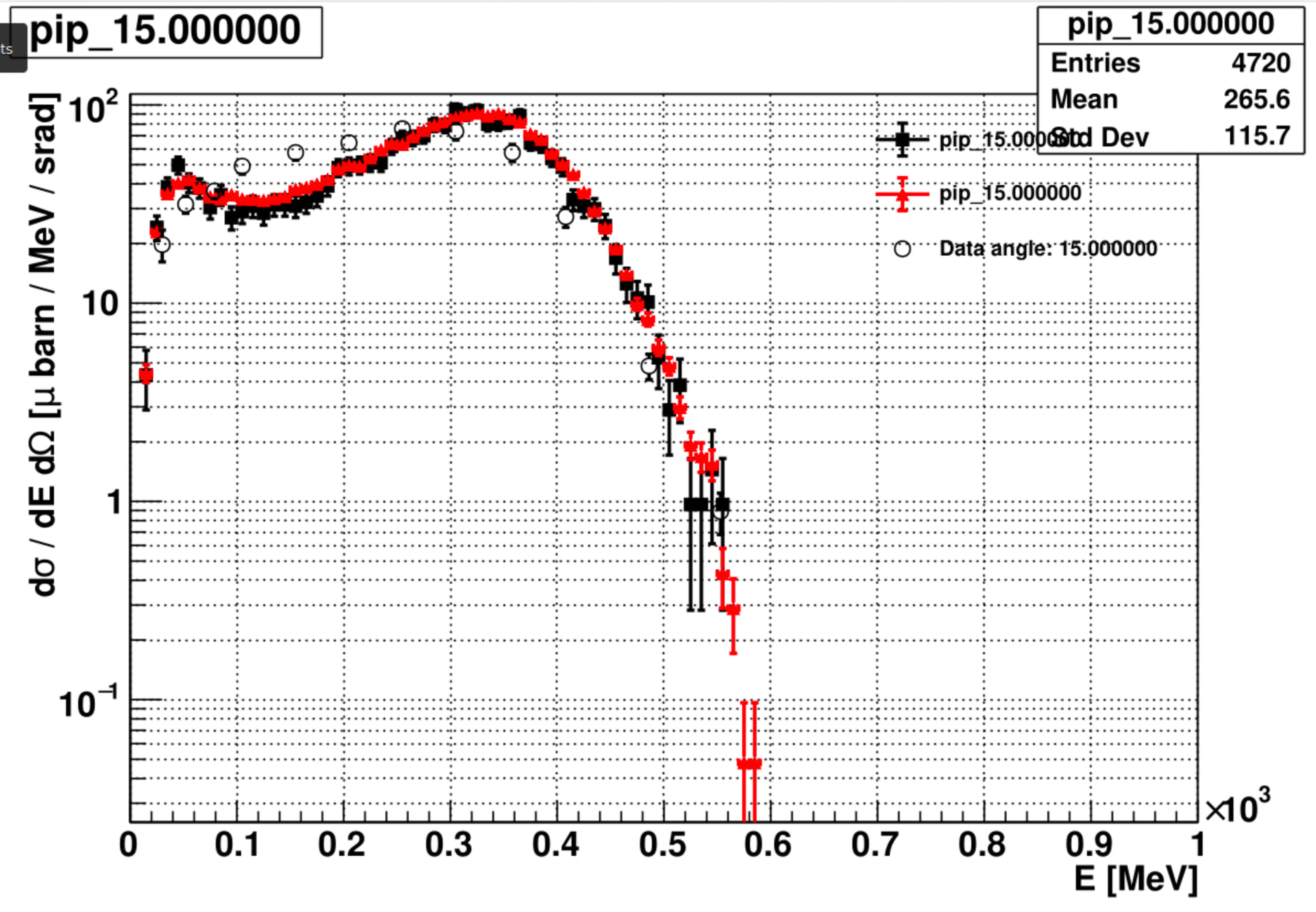
All the results are in the attached PDF file.
out.pdf (197.1 KB)
Bests,
Andrea
