I am currently trying to reproduce the results reported in a published paper https://doi.org/10.1093/rpd/ncad207 using FLUKA. However, my calculated results are significantly lower than those presented in the article.
To estimate the total response, I have used the boundary estimators USRBDX and USRYIELD. I would appreciate your guidance on the following points:
Is there any specific physics model or setting that needs to be explicitly activated in FLUKA to correctly reproduce such results? I am concerned that I might be missing an important physics option.
In my setup, the beam direction is aligned with the normal to the boundary surface. Under this condition, should I expect the results from USRBDX and USRYIELD to be similar, or is it normal for them to differ?
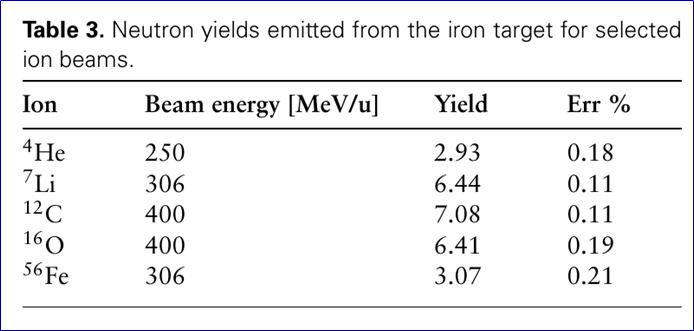
Thank you for your reply.The table of yields are attached for your kind review. I also appreciate your suggestion. During the installation, I included the JEFF-3.3 and ENDF libraries.
I have checked the output of my run, which confirms that the neutron library is being used. In addition, I included the LOW-PWXS card to ensure proper low-energy neutron transport.
However, the total response is still significantly lower in some cases. For example, for the oxygen–iron combination, the reported value is 6.44, while I obtain 4.45. For the helium–iron combination, the reported value is 2.93, while I obtain 0.19. On the other hand, for the carbon–iron combination, the reported value is 7.08, and my result is 7.11, which shows good agreement.
Could you kindly advise whether there might be any missing physics or additional settings that I should consider to improve the agreement for the cases with larger discrepancies?
I would also like to ask a second question. The beam direction is aligned with the normal to the boundary surface. Under this condition, should I expect the results from USRBDX and USRYIELD to be similar, or is it normal for them to differ?
Concerning USRYIELD and USRBDX, they are different estimators that may estimate the same quantity. So, they will get the same value if properly integrated over the surface. So differences can be in set ranges, energies, and surface area. Nevertheless, comparison can be complicated by different approaches to calculating fluence:
Concerning the resulting yield, and its comparison with paper results, I would suggest checking 3 things (I will try to do it also, but it will be good to do it together):
1 - USRYIELD estimates yield for particles crossing the surface, not production yield, so it is very sensitive to the geometry of the target and transport (self-shielding). Self-shielding is available for Fe in Fluka, which suggests the best match of results.
Can you please check the same for other target materials? Does it work the same, I mean FLUKA output?
I believe that for carbon - iron, it can be explained by transport adjustments (which nevertheless should be verified) and cross-section libraries. But for a 10 times discrepancy, there should be a more significant reason, such as an inappropriate cross-section.
I will check it today-tomorrow, if it is not installation dependent, so we will cross-check our results.
One of the options is to preselect using the LOW-PWXS card for a point-wise approach, so you will immediately see available libraries. Then, in errors, you will see if low-energy neutron treatment is activated in the “Neutrons” section, and check for possible errors in the neutron xsec for certain material.
Keep in mind that results depend strongly on the selected library and material within the library.