I’m using FLUKA to simulate the production of At‑211 by α beam bombardment of a bismuth target.
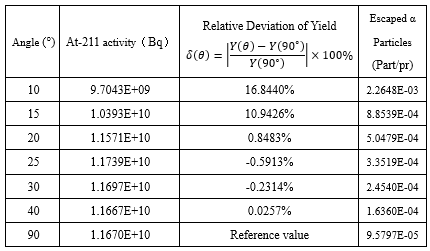
The beam spot is a circle with a diameter of 15 mm (4σ). When the α beam strikes the target surface, it projects an “ellipse” onto the target surface, with the short axis remaining constant and the long axis becoming 1/sinθ times its original length. To ensure complete beam acceptance, the short axis of the elliptical target surface is set to 30 mm, and the long axis is set to 180 mm. The target thickness is 300 μm, which ensures that incident α particles are completely stopped within the target when incident perpendicularly. The simulation conditions are as follows: current of 50 μA, irradiation time of 7 h, and cooling time of 0. The activity of At-211 throughout the entire target is calculated. The angle represents the angle between the beam direction and the target surface. The data in the last column represents the results obtained by completely enclosing the bismuth target with a vacuum sphere and using a USRBDX card to count α particles with energies greater than 20 MeV traveling from inside the vacuum sphere to outside it.
When the incident angles are 10° and 15°, there is a significant difference in the activity of At-211 throughout the target compared to that observed at a perpendicular incident angle. Can anyone explain what causes this phenomenon? How should this phenomenon be analyzed?
The idea of your debugging strategy -count the escaped α particles- is good. If a significant amount of α particles escaped the target, then it would make sense for the At-211 activity to increase with decreasing angle, because the expected path length inside the target would increase.
However, I think something went wrong when you scored the escaping particles.
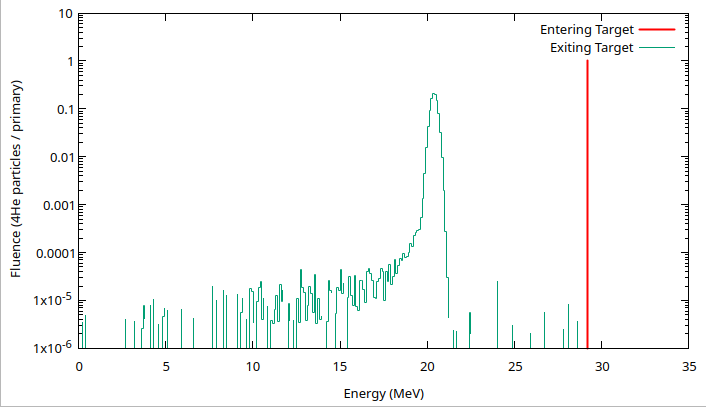
I tried to reproduce your results in a slightly different way, by using one-way USRBDX scorers to record the particles that enter and exit the target region (see attached modification of your input file). The result (see plot below) suggests that a significant amount alpha particles leave the target. In fact, with my poor statistics, the result is indistinguishable from “all particles enter and leave the target”.
This is also expected from stopping-power tables. According to NIST/ASTAR (https://physics.nist.gov/PhysRefData/Star/Text/ASTAR.html), the (CSDA) range of 30-MeV α particles in lead (not bismuth, but should be similar) is on the order of 0.2 g / cm2. For a bismuth density of about 10 g / cm3, the expected range is one the order of 20,000 um compared to the target thickness of 300 um.
Thank you very much for your careful investigation and the modified input file.
I would like to clarify an important mistake in the three input files I uploaded earlier. The target thickness in those files was set to the value corresponding to slowing down 29.3 MeV α particles to approximately 20 MeV, not a thickness sufficient to fully stop the alpha particles. That explains why your USRBDX scoring showed that nearly all incident particles entered and then exited the target volume.
However, the phenomenon I described in my original post comes from simulations with a fixed target thickness of 300 μm. I apologize for this confusion caused by the wrong input files.
According to my SRIM calculation, the projected range of 30 MeV α particles in metallic bismuth is about 216 μm. Therefore, a 300 μm-thick bismuth target is thick enough to fully stop the normally incident α particles.
My initial hypothesis was that the yield drop at small grazing angles arose because the finite target area could not fully intercept the stretched elliptical Gaussian beam. But after expanding the target dimensions, the low-yield behaviour still persists, even when nearly all incoming particles hit the target.
Specifically:
For the 30 × 500 mm target: the yield reduction appears below 8°
For the 30 × 180 mm target: the yield reduction appears below 20°
For the 18 × 100 mm target: the yield reduction appears below 25°
I now know this effect is related to the Gaussian beam profile itself, but the underlying physical mechanism is still unclear to me.
True, after changing the thickness to 300 μm in my simulation, I also found that essentially all particles are stopped. I was expecting my range estimate of the range from the stopping-power tables to be inaccurate, but I am surprised how bad it was. Looks like I was having confirmation bias.
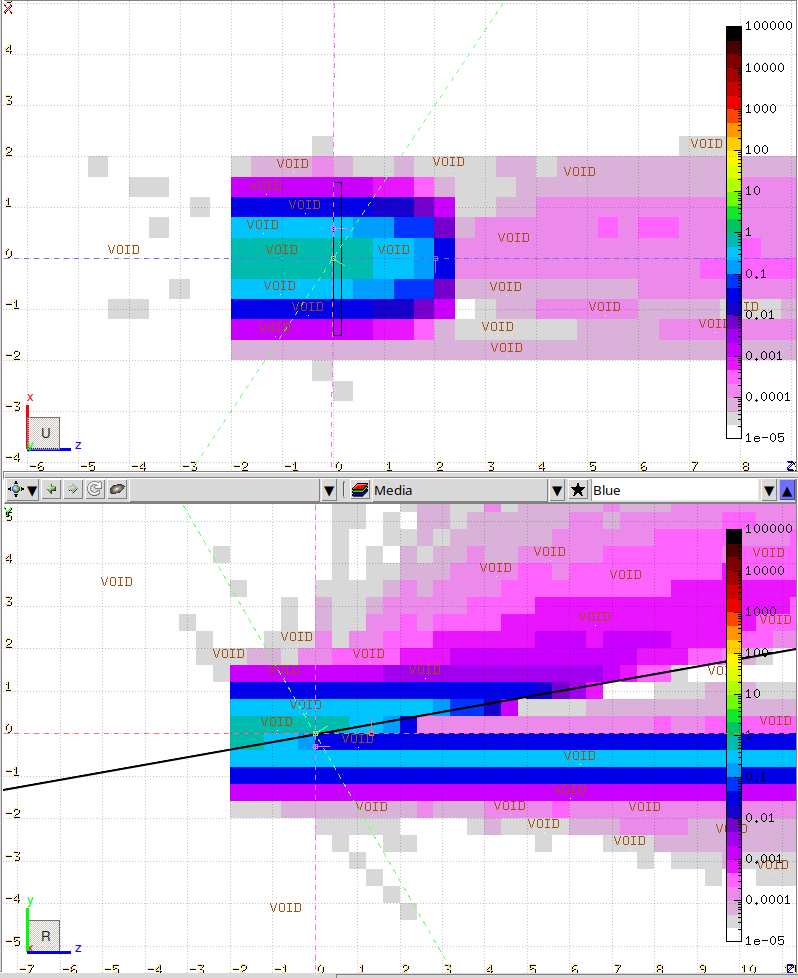
Rotating the target the same way as in one of your original input files and scoring the α-particle fluence with a USRBIN, I found the following: Due to the relatively small beam-to-target distance (2 cm vs. a 3 x 50 cm2 target), a significant part of the beam particles enters the world downstream of the target and leaves the simulation without interacting. See the attached screenshots of a z-x (top) and a z-y (bottom) projection.
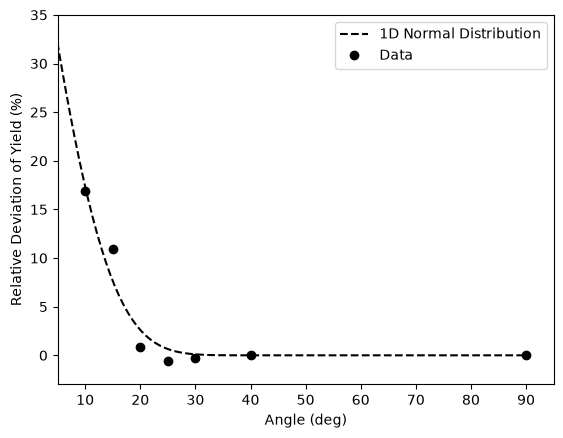
Using a 1D normal distribution along the y axis for simplicity (actually, we are cutting a 2D normal distribution) with a cumulative distribution function CDF and the given FWHM, an angle of β degrees and a beam-target distance d,
(1-CDF(d/tan(90 deg - β)))*100
percent of your beam miss the target. Already this 1D estimate reproduces the trend of your relative deviations quite well.
Sorry for my delayed response. Thank you for your reply. I fully agree with your point of view. In addition, I have re-run the calculations for this problem over the past few days and have gained some new insights.
In this calculation, the beam source was fixed at z = -100 cm. The following calculation results are all based on an elliptical target with a short axis of 18 mm, a long axis of 100 mm, and a thickness of 300 μm. Building on your computational model, I also considered the beam distribution in both the x and y directions. The proportion of particles that did not strike the target was exactly the same for all seven incident angles—1.67%—so theoretically, the yields at each angle should be identical. However, the simulation results show that the relative deviation of the yield at a 10° incidence angle from the 90° reference value reaches 4.46%, and the yield ranges for the two angles do not overlap at all; the yields for the remaining angles are consistent with the 90° reference value and fall within the statistical error range.
Incident angle
At-211 Yield (GBq)
Relative error (%)
Yield range (lower ~ upper)
Missing-particle fraction (%)
Deviation relative of Yield to 90° (%)
10°
10.814
1.026
10.703 ~ 10.925
1.67
4.46
15°
11.499
0.4484
11.447 ~ 11.551
1.67
1.59
20°
11.322
0.5875
11.255 ~ 11.389
1.67
0.03
25°
11.289
0.8747
11.190 ~ 11.388
1.67
0.27
30°
11.305
0.9892
11.193 ~ 11.417
1.67
0.12
40°
11.289
0.6353
11.217 ~ 11.361
1.67
0.27
90°
11.319
0.7374
11.236 ~ 11.402
1.67
(reference)
I then calculated the Gaussian particle acceptance rate of the target surface relative to the incident beam, assuming that all particles had already reached the plane of the target surface. The results are as follows:
Incident Angle
Total Collection Efficiency
Core Collection Efficiency (r ≤ 2σ)
Tail Collection Efficiency (r > 2σ)
90°
98.35%
100%
87.78%
40°
98.29%
100%
87.35%
30°
98.23%
100%
86.93%
25°
98.16%
100%
86.44%
20°
98.02%
100%
85.36%
15°
97.50%
100%
81.53%
10°
93.78%
100%
54.02%
Therefore, I believe that when the beam source is placed close to the target surface, the geometric truncation effect you mentioned is the dominant cause. After relocating the beam source farther away, the main factor responsible for this phenomenon is the substantially reduced collection efficiency of particles in the Gaussian beam tail (r>2\sigma) at small grazing angles, while all particles within the beam core (r\le2\sigma) can be fully intercepted by the target. Would you agree with this interpretation?
Yes, this explanation makes sense, nice follow-up! The ratio between the total collection efficiency at 10 deg and at 90 deg agrees with the yield ratio within the uncertainties:
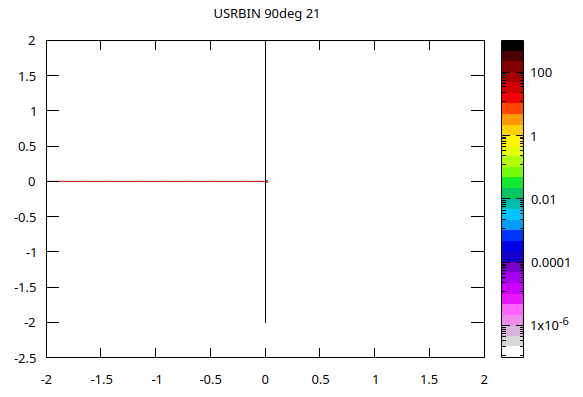
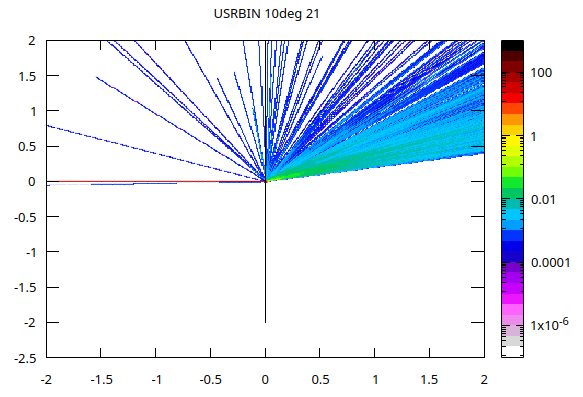
On a sub-percent precision level, there is actually a physical, i.e. non-geometrical, phenomenon that should cause discrepancies. I originally had this in mind as an explanation for your issue, but found that the effect was too small. The idea is the following: With decreasing angle, there is a possibility for alpha particles that are scattered at small forward angles to leave the target again. Since the scattering of the initial 30-MeV α particles should be strongly forward focused, this has a low probability. Even at 90 deg you should have some small amount of backscattering, i.e. the beam will never deposit its entire energy in the target.
I performed a simulation in which I shot 30-MeV α particles on a tilted wall, i.e. an infinitely thick target, and USRBIN-scored the alpha-particle fluence and the total energy deposited in the “target”. The energy deposition per primary was
2.9869(4)E-02 GeV at 10 deg, and
2.9998E-02 GeV at 90 deg (statistical uncertainty smaller than the displayed digits).
In the attached output plot for 10 deg, you can see how some scattered alpha particles move along the surface and leave the geometry. In the 90-deg plot, there is actually not a single backscattering event for 10^4 primaries, which shows how improbable it is.
Thank you for your explanation and simulations. I have also noticed this scattering escape effect before, but I stopped further investigation since its impact is minor.
Now, with our joint efforts, we can reasonably explain the lower yield at small incident angles. Thank you again for all your help throughout this work. Wish you good health.