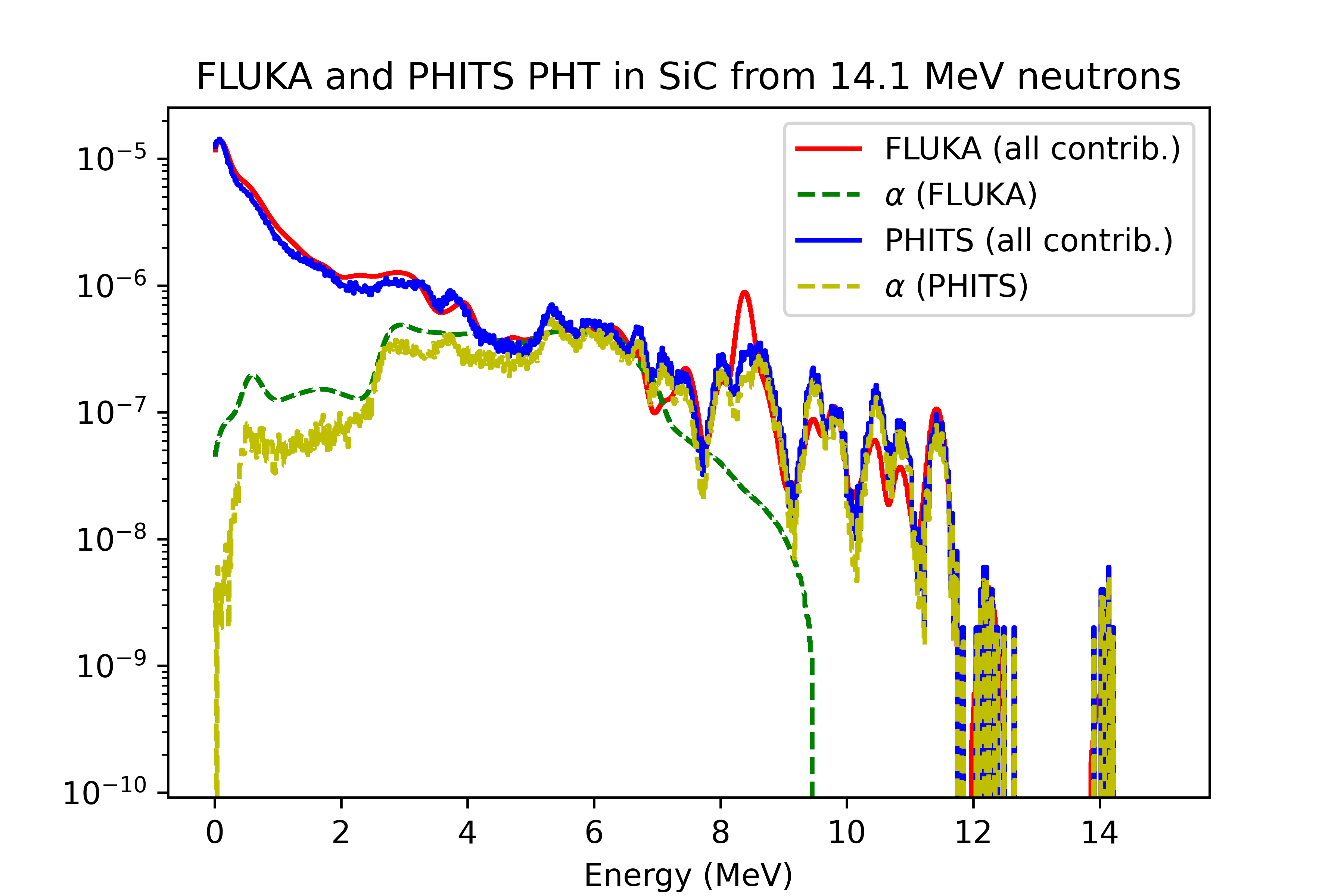
I am simulating the energy deposition in a SiC detector, through the DETECT card and also the comscw routine to select the different contributions, namely for alpha and heavy ions.
The LOW-PWXS card is also used to allow for event-by-event pulse height tally (PHT) and full transport from IONTRANS is also activated.
When I am looking at the contribution of alpha particles, it seems that some peaks are missing, especially after 8 MeV, where peaks from 12C(n,alpha)9Be and 28Si(n,alpha)25Mg should occur. Same problem with a CVD detector, where the peak around 8 MeV from 12C(n,alpha)9Be is missing.
You can see on the attached plot that the PHT with all contributions from FLUKA (in red) is very closed to the PHITS one (in blue), but some differences appear for alpha contributions between FLUKA and PHITS. I can add that this behavior is not depending on the selected library, results are identical with JEFF, JENDL, ENDF or BROND.
Another problem; impossible to run my input with the CENDL3.1 library
Thank you for your help.
Jean-Emmanuel
Input files
Please upload all relevant files. (FLUKA input file, Flair project file, user routines, and data files
Events generating an alpha particle deposit in the detector an amount of energy that is not exclusively due to the alpha, but also to its heavier partner. The logic you implemented in comscw removes the contribution of the latter and thereby displaces the event count to a lower energy on the horizontal axis of the pulse height spectrum.
You should rather disentangle the events featuring an alpha from the others, and consider their full energy deposition. This will make the spectrum with alphas and the spectrum without alphas add up to the total spectrum.
In order to do so, you could for instance add a predefined large energy shift to the first energy deposition by an alpha particle in each event, so as to move the spectrum with alphas say 50 MeV above, and then shift it back when plotting. Here is a working comscw.f
If you want to disentangle events with a certain heavy ion, yes. But note that the respective pulse height spectrum may not be additive with the alpha one, since the considered ion may be produced together with an alpha particle.
Yes. In this case, they are identified by JTRACK < -6 (typically = -7) and their atomic and mass numbers are ICHEAV(-JTRACK) and IBHEAV(-JTRACK) in fheavy.inc.
This should be due to the fact that the library contains only 12C data. Try redefining carbon as a single isotope material.