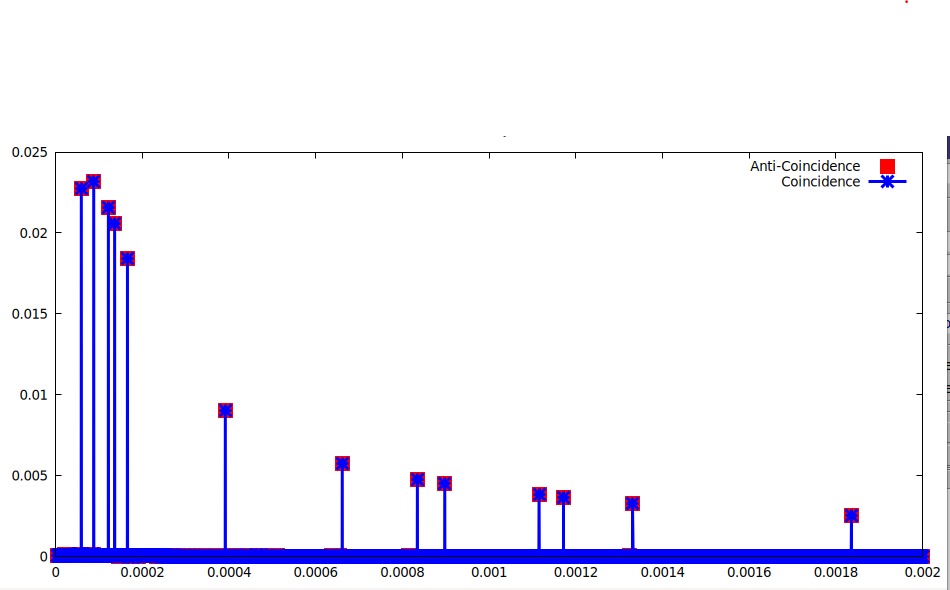
I am working on quantifying the coincidence summing effect in detector. I used the provided input files, where the source is defined via SOURCE_NEWGEN_WITH_REGIONSOURCE with SAMPLE_DISCRETE_MOMENTUM_ENERGY.
As I understand :
-Anti-coincidence mode in the DETECT card allows us to quantify the detector efficiency without coincidence summing effects.
-Coincidence mode in the DETECT card quantifies the efficiency with coincidence
ε_Anti-coincidence/ε_coincidence = represent the number of counts lost due to coincidence summing. is correct ?
However, in my simulation results (see attached figure), I observe that both (Coincidence and anticoincidence) modes give me the same efficiency values, Why ?
The (Anti)Coincidence option is for two separate detector/trigger regions to see if energy deposition happens in both (coincidence) regions or only in the detector but not in the trigger (anticoincidence) during the same primary event.
Since the user routine you are using here is only adding one photon to a primary event, there won’t be any correlation between them. You need to add multiple photons to one event to see coincidence peaks.
Thank you for the detailed explanation. I would like to quantify the coincidence summing correction factor.
As I understand, the DETECT card calculates the number of photoelectric interactions per number of photons that reach the detector region. Please find attached the document illustrating the method I used to quantify the coincidence summing effect. Could you please confirm whether this approach is correct ? coincidence.pdf (199.0 KB)
Best regards
Unfortunately your approach is not correct. In the simulated spectrum, what you see at 2505 keV is the actual 2505 keV peak from the Co-60 decay (see the decay scheme below), not a summing peak, which FLUKA cannot by construction reproduce because it emits uncorrelated particles. For coincidence effects to emerge in your simulation, you will need to load multiple particles per history (or primary event), as @horvathd suggested earlier.
Furthermore, your theoretical approach to calculate the correction factors from a spectrum is also not fully correct. For example, it does not take into account that a fraction of the 1332 keV line comes directly from the β-decay of 60Co without previous emission of the 1171 keV line etc.
Since this falls outside the scope of this forum, I would advise to take a look at a γ-spectroscopy textbook or search online for how coincidence summing correction factors can be analytically calculated for some simple cases, such as Co-60. See, e.g.:
Gamma- and X-ray spectrometry with semiconductor detectors (K. Debertin, R. G. Helmer) (Section 4.5.1)
Practical Gamma‐Ray Spectrometry (G. R. Gilmore) (Section 8.11)