I am simulating backscattered protons from a very thin gold foil (125 nm). To score the backscattered particles, I used an arc-shaped boundary together with the USRBDX card.
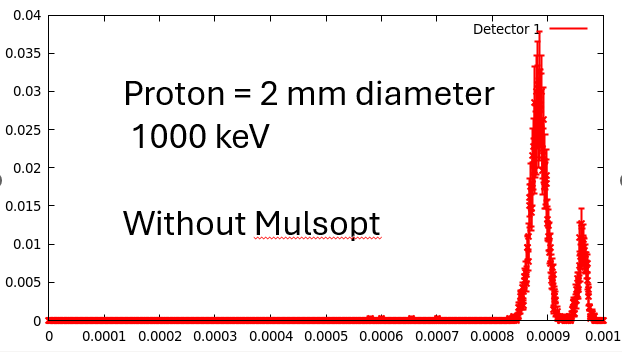
Initially, without using the MULSOPT card, I obtained two distinct peaks in the energy spectrum.
The right-hand peak corresponds to the expected RBS signal, including the energy loss of the scattered protons. However, there was also a dominant peak on the left. For protons contributing to this peak, the path length inside the foil appears to be about 3-5 times the foil thickness. There is also a noticeable energy gap between the two peaks. I also noticed that changing the foil thickness changes the energy gap between the two peaks.
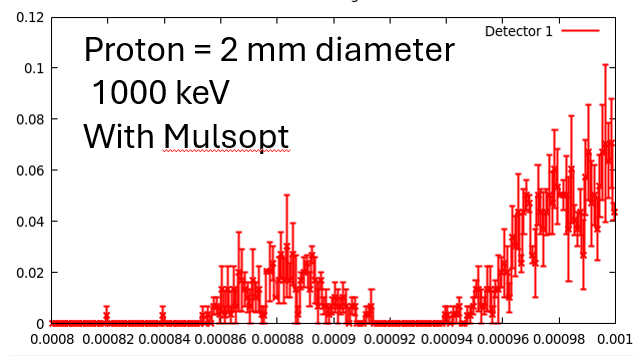
Later, I learned that for very thin foils it is recommended to use the MULSOPT card to enable single scattering. Otherwise, FLUKA uses the condensed-history approach based on Molière theory, which can introduce artifacts for sub-micron targets. After enabling MULSOPT as shown below, I observed a significant change in the spectrum.
My current interpretation is that the previously observed dominant left-hand peak was due to some artifect. After enabling single scattering with MULSOPT, this peak is no longer dominant. This makes me wonder whether the left peak corresponds to large-angle multiple scattering or still some artifact.
Does this interpretation seem reasonable, or do you think there is another effect that I may be overlooking? If there is a better way to analyze or verify the origin of these peaks, I would greatly appreciate your suggestions. I am also worried that using mulsopt, I can see usrbdx directly starting from 1000 keV, which shouldn’t be the case.
As you correctly state, in FLUKA it is recommended to introduce the MULSOPT card and select a single scattering treatment to better simulate the elastic scattering of charged particle in such small material slabs.
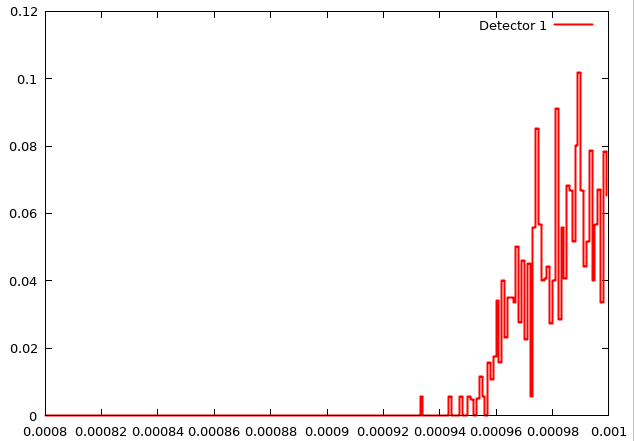
I have been able to reproduce (with a lower statistic) the curves you are showing with and without the use of MULSOPT and I can confirm that the left-peak is just an artefact coming from the Multiple Coulomb Scattering (MSC) treatment.
You can verify this yourself introducing the following card:
where it differs to your case simply for the # scatterings entry which is set to 1000 instead of the default 1. With this card all elastic scattering of the protons in your simulation will be treated in a single scattering regime. This can be verified checking that in output file something similar the following line is printed:
**** ( Total multiple scatterings: 0.0000E+00: Total single scatterings: 2.9766E+07,
Running the same simulation with this card, I get the following results, where the left peak disappears completly:
Just for reference, looking in the output file of the run using MULTOPT card with # scatterings = 1, I find that some scatterings process are still treated as MSC:
**** ( Total multiple scatterings: 1.1261E+07: Total single scatterings: 2.9755E+07,
Regarding the max energy of the backscattered photon, in FLUKA the recoil energy due to large-angle elastic scattering is disregarded, even if the process is described with single scattering theory. So only electrostatic stopping power and nuclear stopping power should be taken into account for the expected max energy of the backscattered photon.
Thank you very much for this meaningful explanation.
Just to confirm once again, if I understand it correctly
I should use the MULSOPT card with #scatterings: 1000, as it will discard the MCS, since FLUKA was showing it as an artifact due to the calculation.
Because in FLUKA the recoil energy due to large-angle elastic scattering is disregarded. For a 1 MeV proton at a 138 degree angle, the energy loss will be 0.9806 MeV. So I can correct it by multiplying the x-axis by K = 0.98?
I also want to do the same for alpha and deuteron particles, so the process will be the same.
Yes, using the MULSOPT card with # scatterings = 1000 will force all protons elastic interactions to be treated in single scattering. As a result, the left-peak will disappear because it is an artefact from the use of MCS theory in a condition (thin slab) where the underlying assumptions of the theory do not work anymore.
As a first estimation, knowing from kinematic evaluations the kinetic energy lost by the proton backscattering at a fixed angle, I would rather subtract such energy from the x-axis of scored proton energy-spectrum. This is just an estimation since the change of energy of the backscattered proton in the material would change its stopping power too…
Same consideration should be done for the elastic scattering of all charged particles.