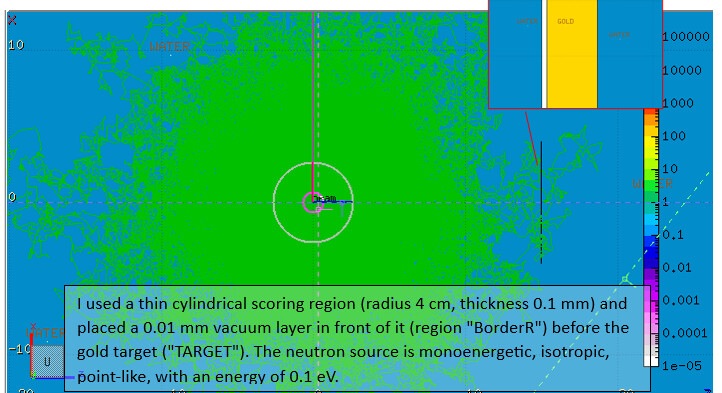
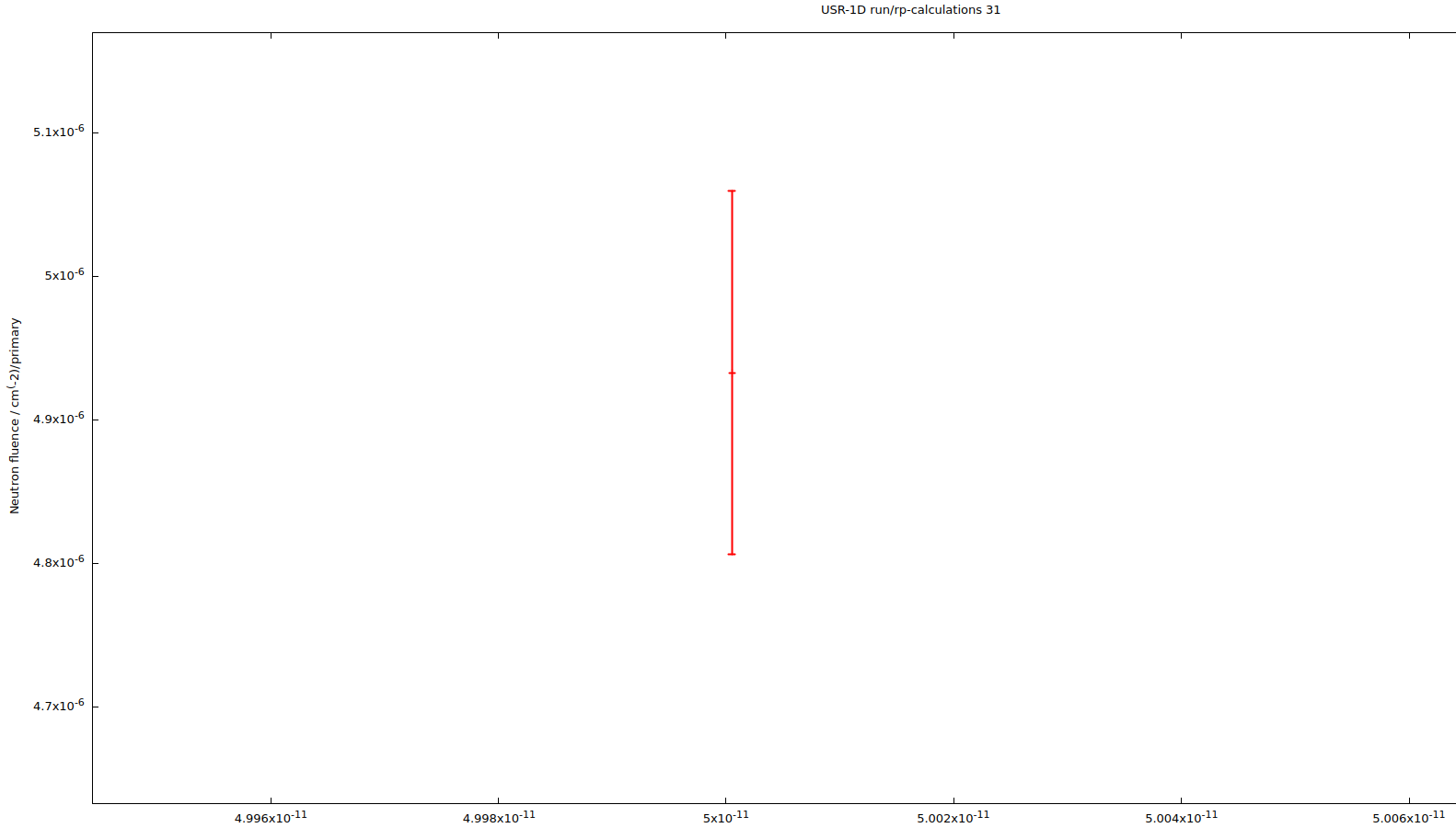
I am trying to benchmark a simple analytical solution for neutron diffusion in water, but my results using USRBDX do not match expectations.
For a point source of thermal neutrons (≈10⁷ n/s) in infinite water at room temperature and unit density, the analytical flux at 15 cm from the source should be ≈1.72×10³ n·cm⁻²·s⁻¹.
In the attached image, I use a small cylindrical region in a water volume (radius 4 cm, thickness 0.1 mm). However, USRBDX gives me a neutron fluence of only ~5.10⁻6 cm⁻² per primary — corresponding to ~50 n/s for a 10⁷ n/s source — far below the theoretical value.
Any suggestions to isolate the problem would be hugely appreciated.
Hallo @Carlos.Vitor
I’m not sure what’s the issue with your - not uploaded - input, apart from poor statistics and a couple of relevant but not exhaustive mistakes in the USRBDX card, where the requested fluence should be bidirectional (Phi2), since roughly half of the neutrons at the scoring surface are backward directed, and the upper energy limit should be higher, since the molecular thermal motion can increase the neutron energy. Nonetheless, implementing your source at the center of an extended water sphere, I get with USRBDX the value you expect (1.72×10³ n·cm⁻²·s⁻¹) on an intermediate spherical surface of 15 cm radius.
Thank you very much for taking the time to repeat the experiment, and apologies for not providing the input file earlier. I have now prepared two input files: One uses my original scoring region (a small cylinder) and the other a spherical shell, as you suggested. In both cases, I get the same flux result, but it is still about half of the expected value. I have also increased the scoring energy range and used bidirectional fluence (Φ2). Could I kindly ask if you could take a quick look at the files? Clearly, I am making the same interpretation error in both. Thank you again for your guidance.
A quick run of your ThermalNeutronsSphere.inp file with several ten thousand primaries and the executable linking your source_newgen.f produces a ThermalNeutronsSphere_21_sum.lis file where I read the expected Tot. resp. of 1.7E-4 n/cm^2 per primary.
The issue is now clear to me — sorry for the confusion. I was reading the value from the tab.lis lethargy plot (dΦ/dlogE), which is not the integrated fluence. Even with a single energy bin I was using, the value still needs to be multiplied by the logarithmic bin width. After checking the output file results instead, I do obtain the expected ~1.72×10³ n·cm⁻²·s⁻¹. Thank you.