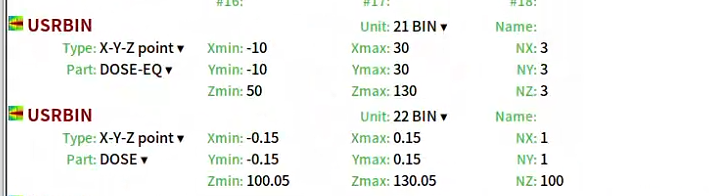
I am trying to use the usrbin does-eq option to calculate the ambient dose equivalent ( H ). The simulation runs successfully when I set WHAT(1)=X-Y-Z, but errors occur when using WHAT(1)=X-Y-Z point. The error message is:
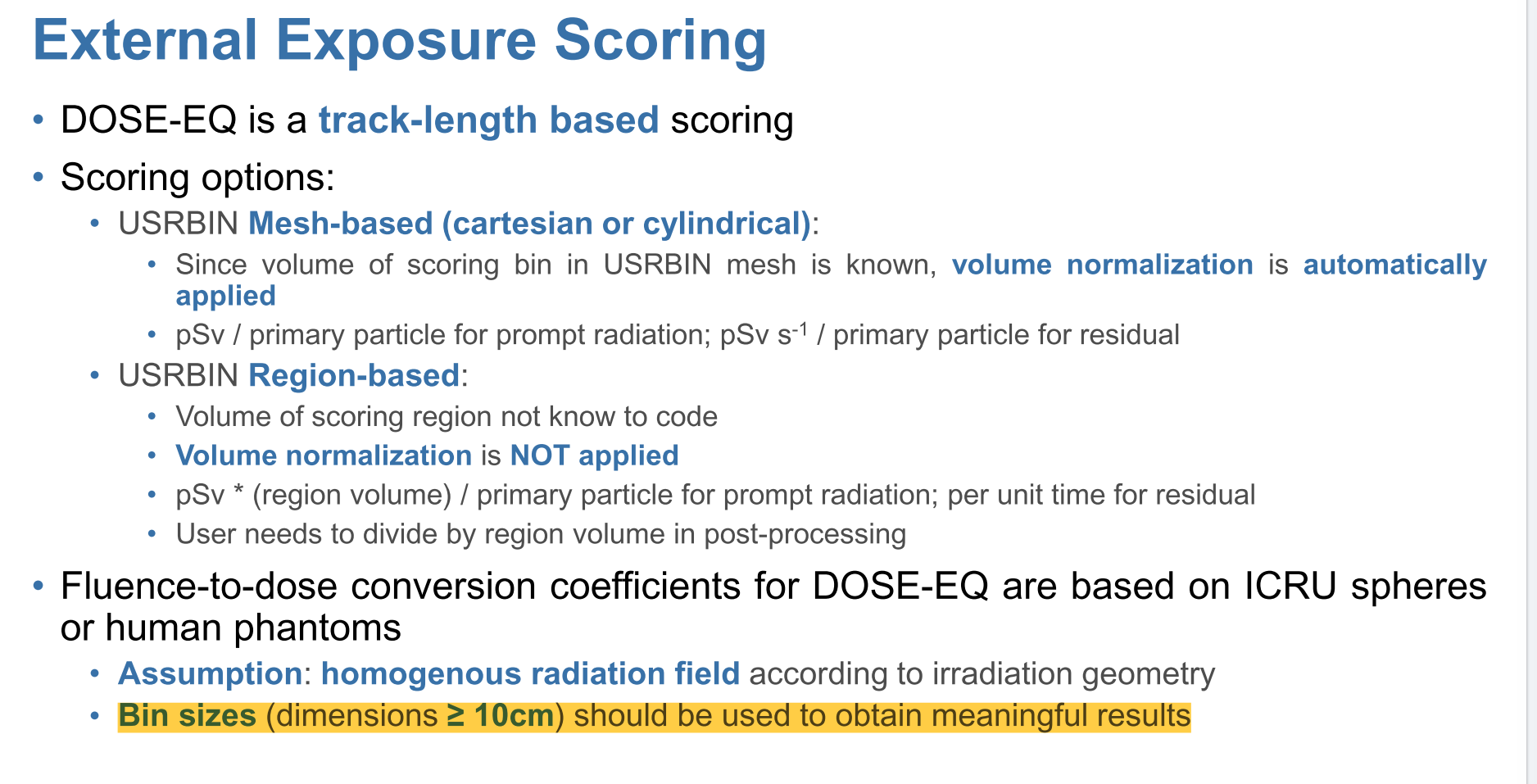
*** Si 1 MeV n eq. or hadrons > 20 MeV binnings must be track-length!!!
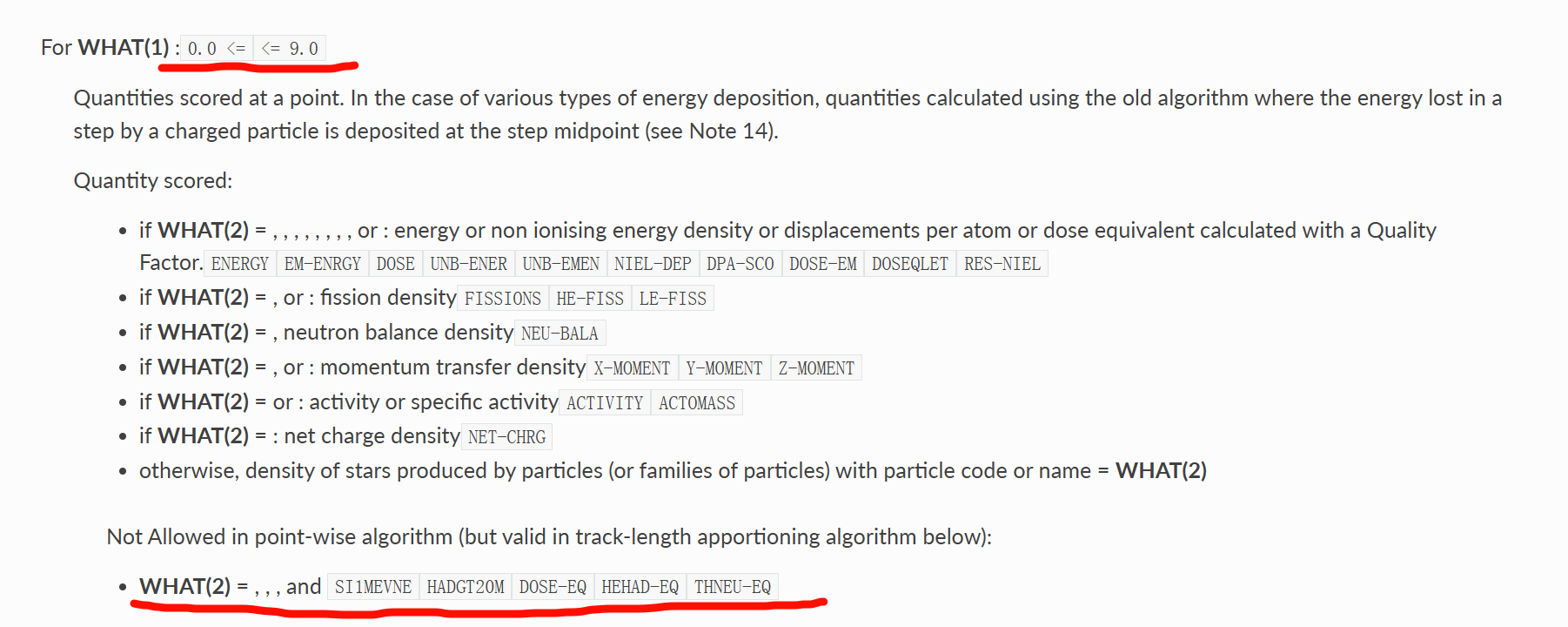
Following the training manual’s suggestion, I increased the bin grid size, but the issue persists. According to the FLUKA manual’s description of usrbin, it states that DOES-EQ “Not Allowed in point-wise algorithm (but valid in track-length apportioning algorithm below)”.
Could you please advise on how to resolve this conflict between DOES-EQ and the point-wise scoring algorithm?
For DOSE-EQ and the other quantities you underlined in red, you must use the WHAT(1)=X-Y-Z option of USRBIN, and not WHAT(1)=X-Y-Z point, according to what you found in the manual. (This has nothing to do with the bin size.)
The manual mentions that when WHAT(2)=DOSE-EQ, WHAT(1)≥10 is required and WHAT(1) < 10 is not allowed. In my understanding, WHAT(1)=X-Y-Z corresponds to values less than 10, while WHAT(1)=X-Y-Z point corresponds to values greater than or equal to 10
Your understanding is wrong, since it’s exactly the opposite, as you can realize looking in the bottom window of Flair, where the selected card is shown as input in FLUKA. There you can see that WHAT(1)=X-Y-Z corresponds to 10, while WHAT(1)=X-Y-Z point corresponds to 0 (default choice).
And your experience (WHAT(1)=X-Y-Z works, WHAT(1)=X-Y-Z point fails) confirms so.
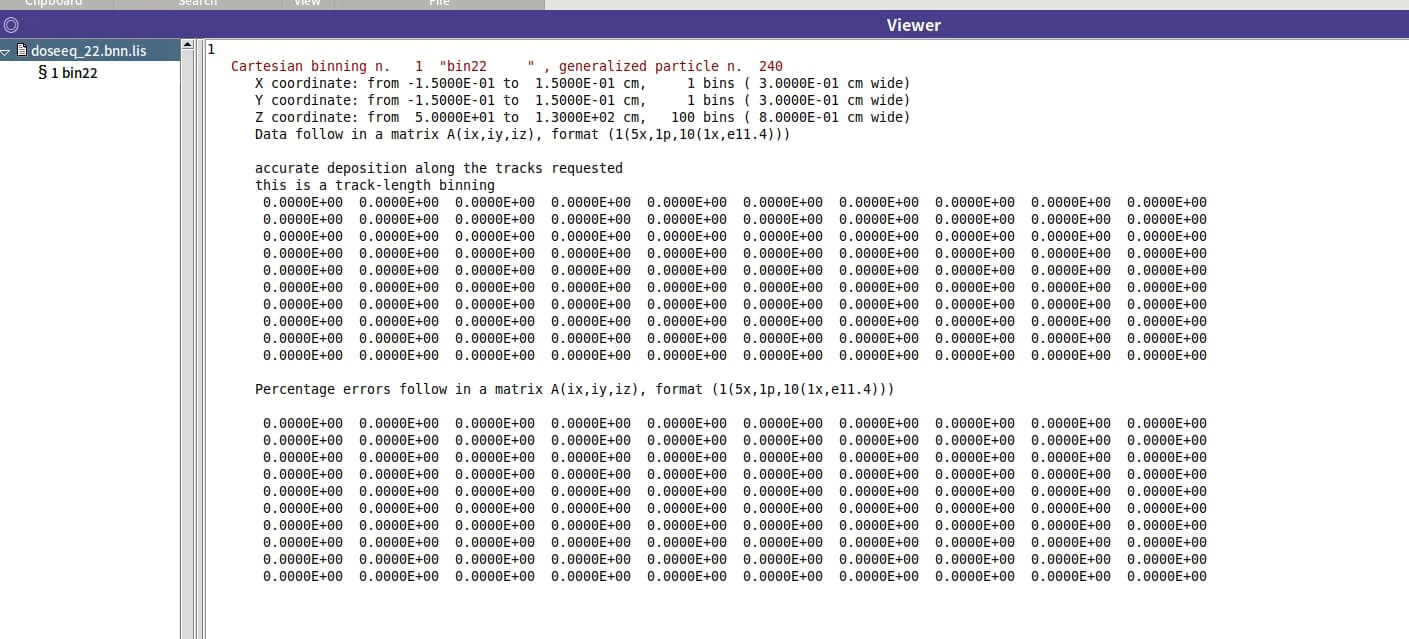
Thank you for your explanations. I mistakenly took the order of arrangement of WHAT(1) in flair-usrbin as its serial code. Following the correct method, I successfully obtained the dose equivalent (pSv/primary) using DOES-EQ. Now, I want to further obtain the ambient dose equivalent rate (pSv/s) over the irradiation time. Therefore, I used the DCYSCORE card to correlate USRBIN with time, but the result I got is 0. My input file is a phase space file containing photons and electrons. Could there be an issue with my settings? doseeq.flair (2.6 KB)
DCYSCORE, requiring also RADDECAY, is meant to calculate the delayed dose due to material activation (which might not be your actual goal, see below). With an electron/photon source, you get no activation out of your simulation in the absence of PHOTONUC.
Moreover, note that by construction your second BEAM card overwrites the first. I’m not sure about the role of your SOURCE card either.
According to your IRRPROFI and DCYTIMES setup, you seem to be interested in the prompt (not delayed) dose rate at the beginning of the irradiation, which will remain the same all along the irradiation. This, as mentioned above, does not require at all RADDECAY/DCYSCORE/IRRPROFI/DCYTIMES, rather to multiply the prompt result by the beam current.
Thank you for your explanations. I understand now.
.[quote=“Francesco Cerutti, post:7, topic:7664, username:ceruttif”]
我也不确定你的源卡的作用
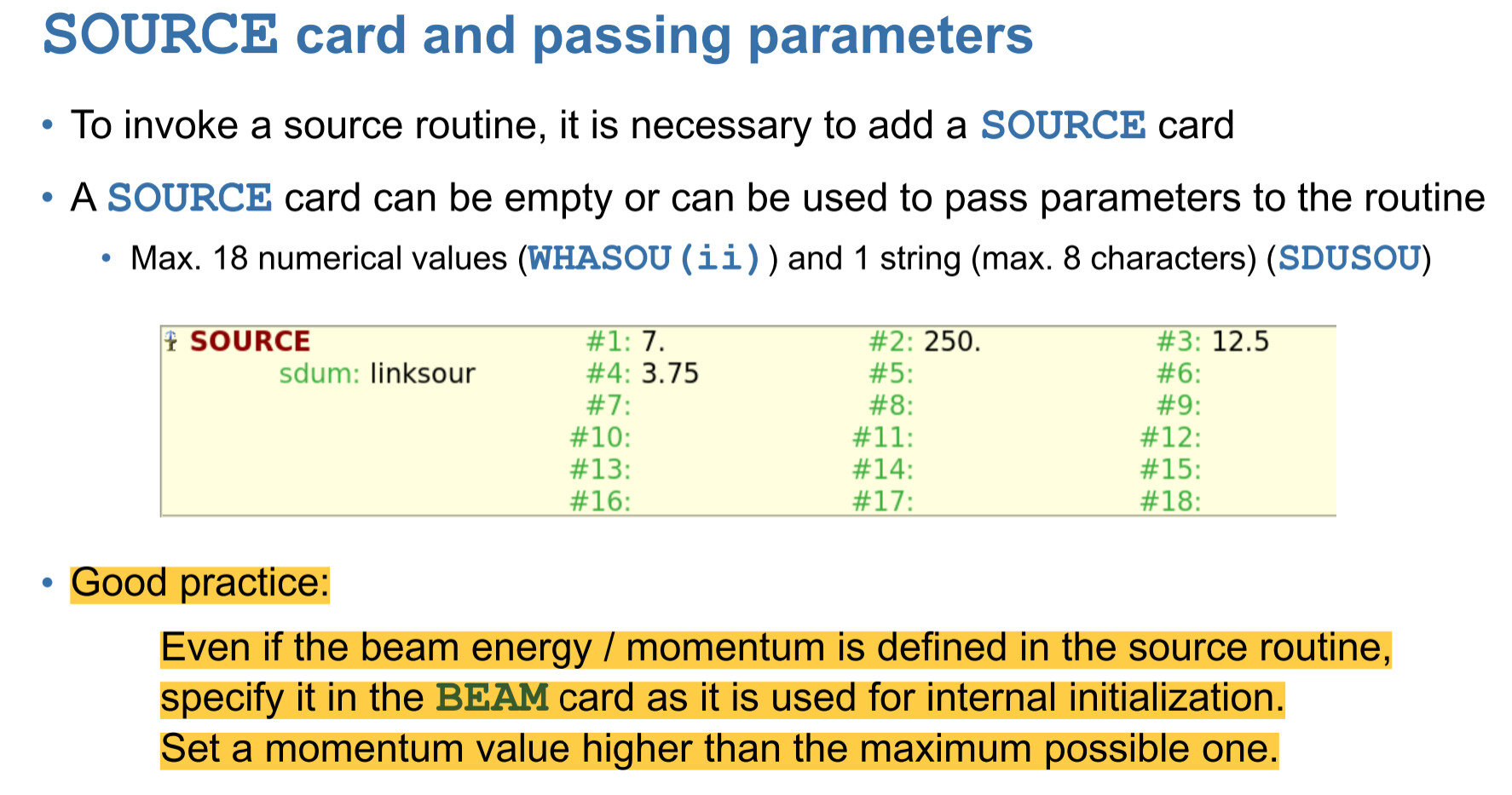
[/quote] My SOURCE card is used to call source_newgen.f, which is for reading a phase space file that records electrons and photons. I set up two BEAM cards according to the instructions in this image. If they are not needed, I will delete the BEAM cards.
One BEAM card is needed, not two (as mentioned, the last one overwrites any previous BEAM card anyway). With a source routine specifying the source particle information, what still matters is the BEAM card momentum/energy value, which is used to set the upper limit of the stopping power tabulations.