I am calculating Primary Knock-on Atom (PKA) energy spectra from a Zirconium target under PWR neutron irradiation using a custom MGDRAW routine. The resulting spectrum shape is physically incorrect compared to established reference calculations from SPECTRA-PKA and standard neutron damage theory.
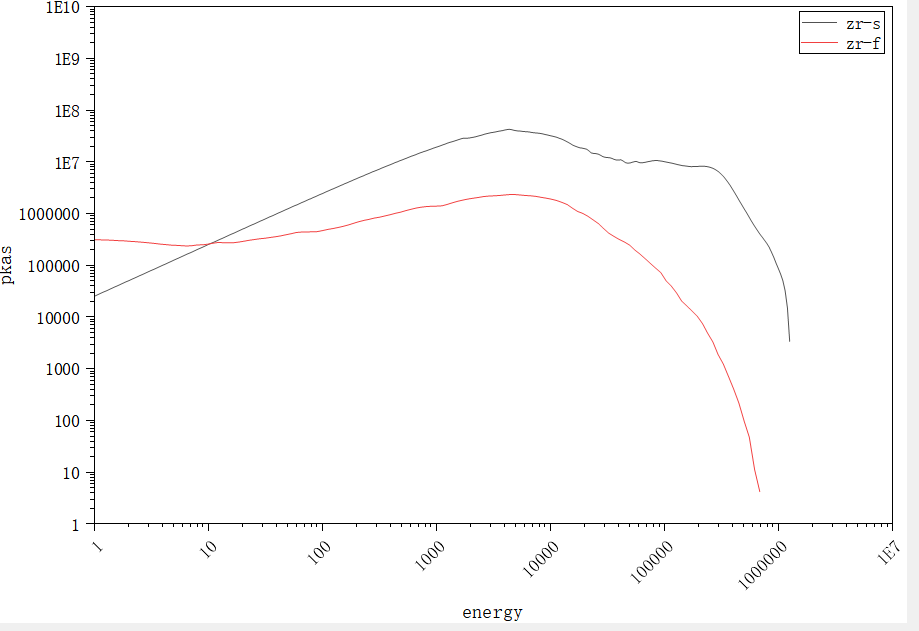
The FLUKA spectrum peaks at approximately 40 keV, whereas the expected peak from SPECTRA-PKA and theoretical models occurs at approximately 1 MeV. This represents an energy shift of roughly one order of magnitude. The FLUKA spectrum also shows severely suppressed amplitude at the peak, a nearly flat distribution from thermal through epithermal energies instead of the expected continuous rise, an abrupt high-energy cutoff around 200 keV rather than a gradual tail extending to multi-MeV energies, and an overall narrow distribution lacking the expected breadth across the full neutron energy range.
This shape discrepancy suggests a fundamental problem in how neutron-induced recoils are being generated or recorded, rather than a simple normalization issue.
The consistent spectrum shape across different filtering approaches suggests that all recorded PKAs are being generated through the same underlying physics mechanism, and alternative channels that should produce high-energy recoils are not being activated or recorded.
In the given plot the zr-f (red) is for FLUKA and (zr-s) for spectra.
Please refrain from bold conclusions and rather focus on the accuracy of what you report. In fact, the PKA spectrum produced by FLUKA for a PWR neutron spectrum on Zr (adopting the ENDF-VII.1 neutron library you picked up)
Thanks for the valuable suggestion but just for your clarification, The SPECTRA-PKA manual examples use a specific reference spectrum for their calculations. However, I am using a different neutron spectrum for my analysis, as the spectrum in the manual does not match my specific irradiation conditions.
My question: Should the PKA spectrum shape remain consistent regardless of the input neutron spectrum (with only the magnitude varying), or can differences in the low-energy neutron region alter the shape of the resulting PKA distribution? I want to clarify whether my observed differences are due to the spectrum choice or indicate a problem with my simulation setup.
Of course a different neutron spectrum may alter the PKA spectrum shape.
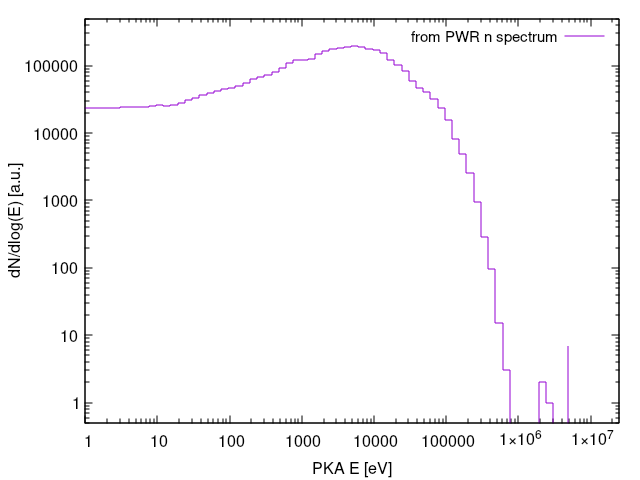
My figure above was obtained with the PWR spectrum yourself uploaded, and looks rather similar to your red curve. If your black curve was generated by Spectra-PKA with a different neutron spectrum, as it seems to be case since it does not match the reference plot I linked, you should make sure to properly use that neutron spectrum in FLUKA.
I want to confirm that I am indeed using the correct neutron spectrum for FLUKA, and follows the format with three columns: Emax, Emin, and dn/dt. If you would like, I can send you the full spectrum data either privately or here in the forum for further validation. I think there is no issue in my spectrum file that i used in source_newgen.f file but if you want to review then i will share you.
Your upload failed: no sp.txt file can be found.
Also, if you want us to have a further look at your source and mgdraw routines, please upload them here too, since the prospect of digging into your previous posts to pick up among multiple files the good version of either is not going to materialize.
You uploaded again the same identical neutron spectrum I already used to produce my figure above with FLUKA (by taking TKHEAV(1) as the PKA kinetic energy).
This neutron spectrum is actually similar to the test PWR spectrum provided with SPECTRA-PKA, yielding through the latter the reference figure I linked above, which is consistent with the FLUKA one.
If with your neutron spectrum you obtain from SPECTRA-PKA the black curve of your plot above, there is a problem with your SPECTRA-PKA calculation, since it does not reproduce the expected SPECTRA-PKA reference figure.
I believe that this dismisses any fundamental problem in how neutron-induced recoils are being generated or recorded in FLUKA.