Dear FLUKA experts
Now, I am attempting to use FLUKA to simulate muons through the scintillator: a muon beam is transported into an EJ-200 scintillator, where it subsequently decays into an electron.
But I want to ask: I set the material “Polyvinyltoluene” which exists in the materials library. So now does FLUKA already know that this material is EJ-200? Do I not need to set any other cards to make it scintillate and emit light when hit by muons? Or do I still need to set up OPT-PROD and OPT-PROP cards, and use a user routine to input the EJ-200 emission spectrum in order to correctly simulate its scintillation? Could you give me some advice?
I have uploaded the .inp and hope you can help me resolve the issues. I would be grateful.
Even if you found the material in the material database, FLUKA does not know about its optical properties. You will need to minimally use one OPT-PROP and one OPT-PROD card to active transport and production in the material.
The only materials which do not need the OPT-PROP cards are vacuum and air, and for these, an index of refraction of one is assumed. For all other materials, you should explicitely provide the optical characteristics.
As for the emission spectrum, if up to 3 lines of emission are detailed enough for you then a series of OPT-PROD cards will suffice. It is not possible to simulate a continuous emission spectrum even with a user routine.
Thank you for your response. I’d like to clarify one point: Is it correct that neither the opt-prop card, nor the opt-prod card, nor user routines can simulate spectra, but can only simulate a few emission lines (where photons in each emission line have the same wavelength)?
Yes, you understood right. Note that, however, you can generate primary optical photons with an arbitrary energy distribution using a SOURCE routine. I mention that in case that would help.
Thank you for your reply. Now I have an inp file that describes muons striking the EJ-200 (a box-shaped scintillator), and I want to study the scintillation light it produces. The base material of EJ-200 is Polyvinyltoluene. The properties of the EJ-200 scintillator are described at EJ-200, EJ-204, EJ-208, EJ-212 - Plastic Scintillators - Eljen Technology .
Could you please check if the opt-prop and opt-prod cards in my inp file are set correctly? Although my program runs (Also, the simulation is running a bit slow.), I’m not sure if they are right. Also, I would like to know if I should enable the EMF and EMF-FLUO cards? (Enabling or disabling the EMF and EMF-FLUO cards does not seem to affect the production of photons.)
It seems you have set up correctly the OPT-PROP and OPT-PROD cards in your simulation. It is normal that your simulation runs more slowly because a very large number of optical photons must be tracked by FLUKA. If the simulation is really running too slow, I suggest you try reducing the conversion fraction in the OPT-PROD card and then correct for the reduction when doing the analysis later.
Also, note that the card EMF-FLUO has nothing to do with optical photons in FLUKA. The card simply improves the treatment of photoelectric interactions. Consult the relevant manual page for more details: 7.22.23. EMFFLUO — FLUKA Manual .
Now I have a new confusion: why is there no change in the number of photons produced after I reduced the conversion fraction in the optprop card by two orders of magnitude? Shouldn’t the number of generated photons decrease in theory?
The number of optical photons should change. Do you mean the OPT-PROD card (not OPT-PROP)? You changed the “fraction“ parameter of the OPT-PROD card that’s correct?
Do you have other production card for optical photons? And how do you know you produce more?
Dear Benoit Lefebvre
Yes,Yes, you aright. Change the fraction in the OPT-PROD cards not the OPR-PROD, I misspoke.
As for how it was discovered that the photon count remains the same after altering the fraction, you can refer to the question post in the link below, which was also posted by me. I used the USDRAW entry in mgdraw to record the light emission of each muon entering the scintillator. After changing the fraction, I compared the results and found no variation in the light emission when muons entered the scintillator. I am quite puzzled by this.
To really make sure, I suggest you use a built-in detector such as USRBIN or USRBDX to estimate the fluence. This is less prone to errors and complications in interpretation when MGDRAW. Normally, the fluence you score should be proportional to the fraction in the OPT-PROD card. If not the case, please attach your flair input as a reply.
Dear Benoit Lefebvre
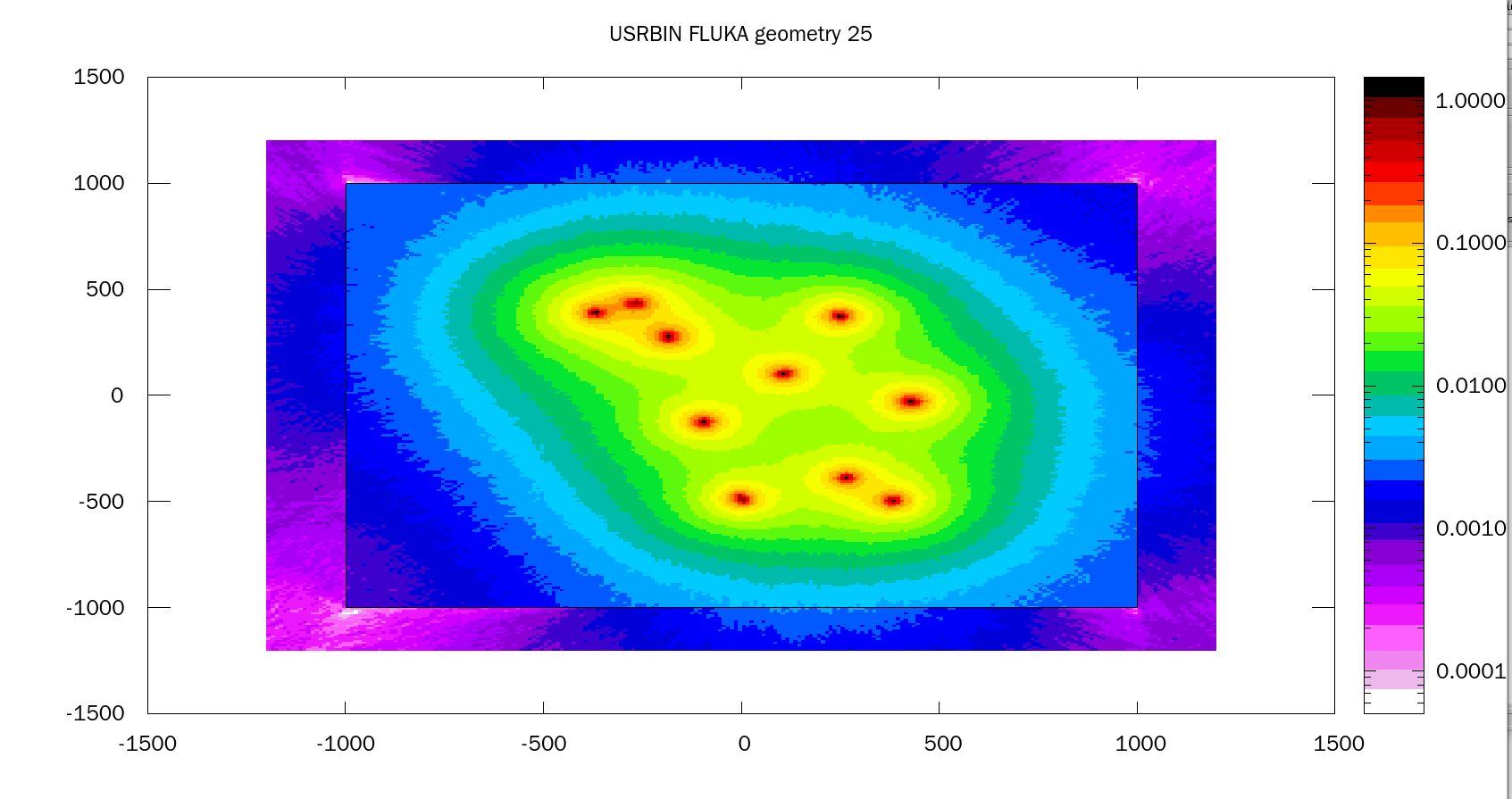
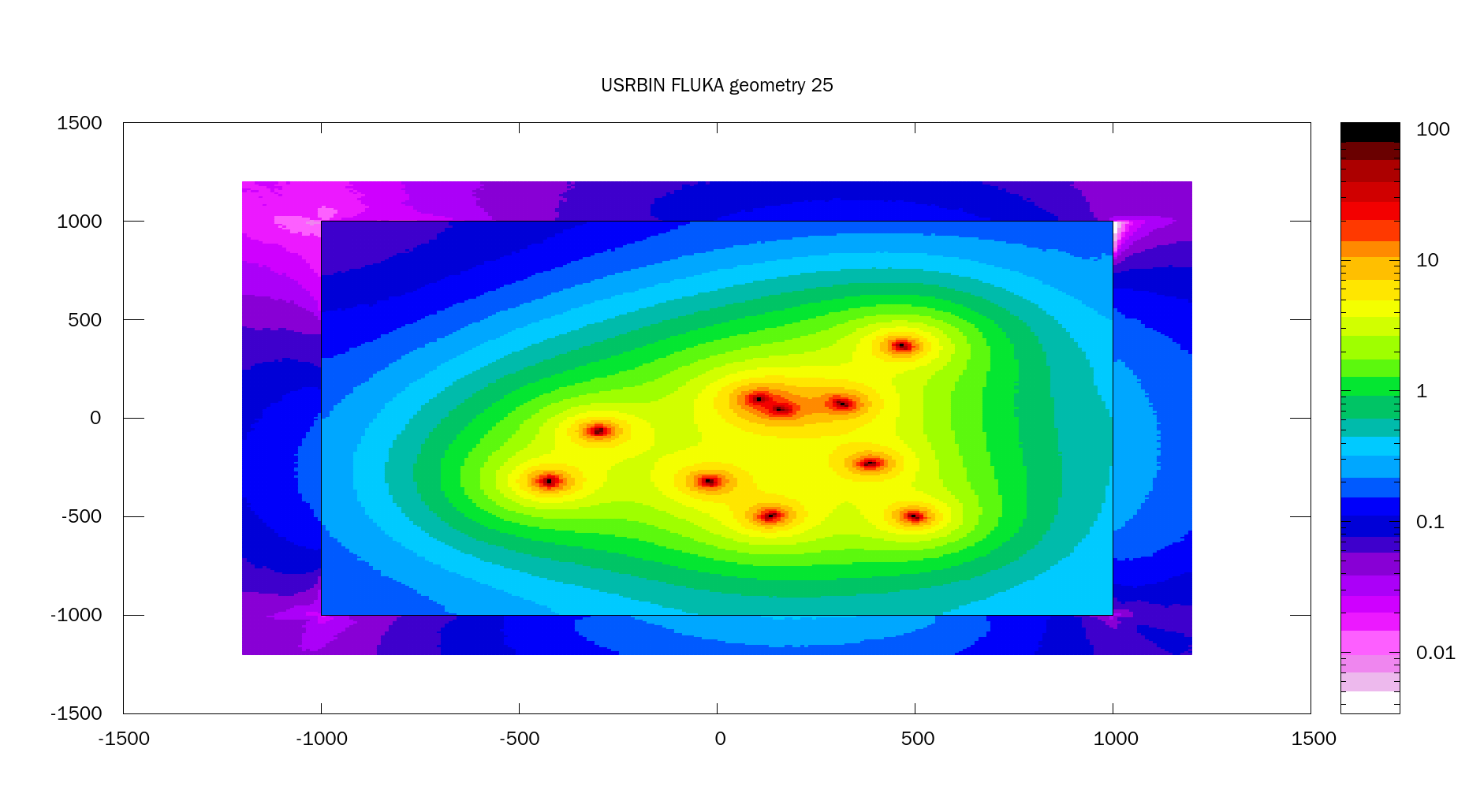
Yes, after using usrbin, I found that changing the fraction resulted in a proportional increase in the number of generated photons, as shown in the figure below.
I also identified the issue from before: I was recording particle information in mgdraw for 7 (gamma photons) instead of -1 (optical photons), which caused the previous problem.
However, when I tried to record optical photons using mgdraw, I found that I couldn’t capture them. I’m unsure why this is the case.
I am glad your results now make more sense. If you would like to get support regarding the use of MGDRAW, please create a separate topic on the forum with a detailled description of your issue.